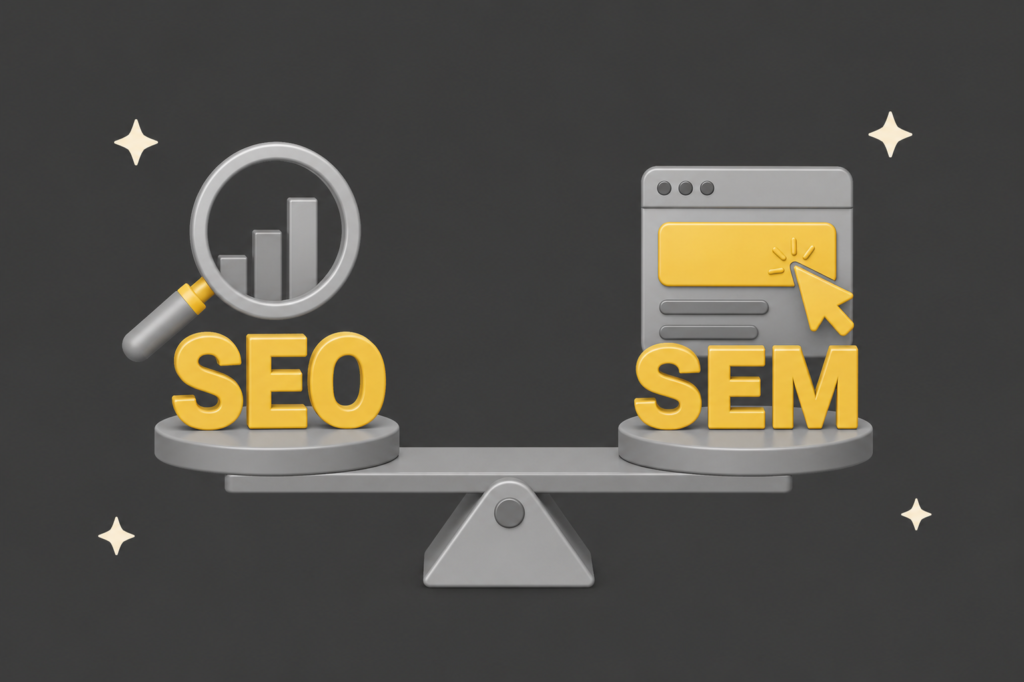
TL;DR: SEO vs SEM the simple differences; SEO earns you free, organic clicks over time. SEM buys you instant visibility through paid ads like Google Ads. SEO builds a long-term asset; SEM rents short-term attention.
They solve different problems, so the smart question is not “which one wins” but “which one for which job.” For most small UK businesses, the sensible play is to make SEO your foundation and use SEM in targeted bursts.
And to clear up the most common mix-up straight away: SEM means paid search advertising, not social media marketing.
If you have ever wondered what the difference is between SEO and SEM, you are not alone. The two terms get thrown around as if they are interchangeable, when in fact they do very different jobs.
Both aim to get your business visible on Google. But the way they do it, and what happens to that visibility over time, could not be more different. Understanding that difference could save you a lot of wasted budget.
There is also a surprising amount of muddled advice out there, including posts that confuse SEM with social media marketing. So let us clear the whole thing up properly, with real UK figures and an honest look at how search is changing in 2026.
What SEO and SEM actually mean
Let us nail the definitions first, because getting them wrong is where most confusion starts.
SEO (Search Engine Optimisation) is the practice of improving your website so it ranks higher in the organic, unpaid search results. You earn your position by publishing genuinely useful content, sorting out the technical side of your site, and building authority over time. You do not pay Google for the click.
SEM (Search Engine Marketing) is the broader term for getting visibility on search engines, and in everyday use it almost always refers to paid search advertising, like Google Ads. You bid on keywords, your ad appears at the top of the results, and you pay each time someone clicks.
In one line:
- SEO = organic visibility you earn
- SEM = paid visibility you buy
Both can appear on the same Google results page for the same search. The difference is how you get there, what it costs, and what happens when you stop.
The core difference: an asset vs a rental
The single most useful way to think about this is property.
SEO is like buying a house. It takes a deposit, it takes time, and the returns build slowly. But once you own it, it keeps working for you. A blog post that ranks well can bring in leads for years without you paying for each visitor.
SEM is like renting. You get the keys today, you are visible immediately, and that is brilliant when you need it. But the moment you stop paying rent, you are out on the street. Turn off your Google Ads budget and your visibility vanishes the same afternoon.
Neither is “better.” A business sometimes needs to rent and sometimes needs to buy. The mistake is treating a rental like a long-term investment, or expecting an investment to pay out next week.
How they compare, side by side
Here is the honest breakdown across the factors that actually matter to a small business.
Swipe to see more < >
| Factor | SEO (Organic Search) | SEM (Paid Search) |
|---|---|---|
| Cost model | Time or agency fees, no charge per visitor | Pay-per-click, charged on every click |
| Time to results | Slow: 3 to 6 months | Instant: live in hours |
| Longevity | Compounds over time | Stops when budget stops |
| Typical UK cost | Upfront effort, then free clicks | Approx £3.50 average CPC, £10+ in competitive sectors |
| Traffic quality | High intent, trusted | High intent but costs per click |
| Control | Full control of strategy and content | Shaped by auction and bidding algorithms |
| Best for | Sustainable, long-term local growth | Launches, promotions, fast keyword testing |
| What you own | A lasting asset | Rented attention |
A few of these deserve a closer look.
Time to results. SEO typically takes three to six months to show meaningful movement, sometimes longer in competitive sectors. SEM is effectively instant: you can be live and visible within hours of launching a campaign.
Cost model. SEO costs you time, or an agency retainer, but not per visitor. SEM charges you for every single click, whether that visitor buys or bounces.
Longevity. This is the big one. SEO compounds. The work you do this month keeps paying out next year. SEM stops dead when the budget does.
What SEM actually costs in the UK
Let us talk real numbers, because “it depends” is not helpful when you are trying to budget.
In the UK, the average cost-per-click on Google Ads in 2025 sits somewhere around £3.50 to £3.65 across all industries, though benchmarks vary a lot depending on who is measuring. For lower-competition sectors like arts, crafts, or food, you might pay anywhere from a few pence to about £1.50 per click. For high-value, competitive sectors it climbs sharply: legal services routinely run £5.50 to £7 per click, and the most cut-throat finance and insurance terms can exceed £10, occasionally far more.
The point is that SEM is a tap you have to keep paying to leave running. SEO, by contrast, has a higher upfront effort and a slower payoff, but no per-click meter. Once a page ranks, the clicks are free.
Where the clicks really go (and why it’s changing)
For years the standard SEO sales pitch leaned on a stat that around 94% of search clicks go to organic results and only 6% to paid ads. That figure is real and comes from a GroupM and Nielsen study, but it needs a serious caveat in 2026, and we would rather be straight with you than cherry-pick.
The picture is shifting. Recent analysis from Similarweb covering early 2025 into 2026 found that organic click share has dropped between 11 and 23 percentage points year on year across several retail verticals, while paid ads have gained ground in every category measured. Google’s AI Overviews and a more aggressively monetised results page are reshaping where clicks land.
So the honest summary is this: organic search still wins the majority of clicks for most informational and local searches, and it remains the better long-term value. But paid search is taking a bigger slice than it used to, especially for commercial, “ready to buy” queries. That is an argument for using both intelligently, not for abandoning either.
When to use SEO vs SEM
There is no strict either/or, but there is a sensible order.
Lead with SEO when you want to:
- Build sustainable, long-term growth that does not evaporate when you stop spending
- Get found by people in your area who do not yet know your name
- Compound your investment so each month builds on the last
- Keep your cost-per-lead falling over time rather than rising
Reach for SEM when you want to:
- Launch a new product or promotion and need eyes on it today
- Test which keywords actually convert before committing to SEO effort
- Cover a seasonal spike (think a florist at Valentine’s, an accountant at tax deadline)
- Compete for a high-intent term while your organic ranking is still climbing
In most small-business cases, SEO should be the foundation and SEM the supplement. A neat way to run it: use SEM to learn fast which keywords convert, then pour your SEO effort into ranking organically for the winners so you eventually stop paying for those clicks.
Don’t forget content: it powers both
Whichever route you take, content is the engine underneath it.
SEO obviously runs on content; helpful, relevant pages are literally what Google ranks. But SEM depends on it too. A Google Ad sends people to a landing page, and if that page is thin or irrelevant, two things happen: people bounce, and Google’s Quality Score penalises you with higher click costs. A strong Quality Score can cut your CPC by 20% to 40%, so good content quite literally makes your paid ads cheaper.
This is also why owning your platform matters. When you publish on social media, you are pouring your effort into someone else’s asset, subject to their algorithm and their rules. When you publish on your own website, that content builds your authority, strengthens your SEO, and keeps working long after you hit publish. It belongs to you.
So, which one is right for you?
If you take one thing away: SEO builds equity, SEM buys attention, and the best strategy usually uses both in the right order.
For most small UK businesses, especially local ones, the sensible play is to treat SEO as your long-term foundation, because it is sustainable, it compounds, and it keeps delivering without a meter running. Then layer SEM on top for the moments that genuinely need instant visibility: a launch, a promotion, a seasonal push, or a quick test.
What you should not do is rely on paid ads forever as a substitute for organic visibility. That is renting your entire shopfront indefinitely, and the rent only goes up.
SEO vs SEM: frequently asked questions
Is SEM the same as PPC or paid search?
In everyday use, yes. When people say SEM they almost always mean paid search advertising, and PPC (pay-per-click) is the pricing model that powers it, so the terms get used interchangeably. Strictly speaking, SEM is the broader idea of marketing on search engines and can include SEO too, but in practical conversation "SEM" means your Google Ads and other paid search ads.Is SEO or SEM cheaper?
It depends on the timescale. SEM has a lower barrier to entry because you can start small, but you pay for every click forever, and UK costs run from a few pence up to £10 or more per click in competitive sectors. SEO costs more in upfront time or agency fees and takes months to pay off, but once a page ranks the clicks are free. Over a year or two, SEO is usually the cheaper route per lead. For a quick burst of visibility today, SEM is cheaper to get going.How long does SEO take to work?
For most small businesses, expect three to six months before you see meaningful movement in rankings and traffic, and longer in competitive sectors. SEO compounds, so the gains build over time rather than arriving all at once. If you need visibility this week, that is a job for SEM, not SEO.Should a small business do both SEO and SEM?
Usually yes, but in the right order. Treat SEO as your long-term foundation because it is sustainable and keeps working without a meter running, then layer SEM on top for moments that need instant visibility, like a launch, a promotion, or a seasonal spike. A smart approach is to use SEM to find out which keywords actually convert, then focus your SEO effort on ranking organically for those winners so you eventually stop paying for the clicks.Does paying for Google Ads improve my organic rankings?
No, not directly. Google has stated plainly that running Google Ads does not boost your organic search rankings, and its paid and organic systems are kept separate. Ads can help indirectly by raising brand awareness and sending engaged visitors to your site, which may strengthen signals that support SEO over time, but you cannot simply pay your way to a higher organic position.Which is better for a local business like mine?
For local businesses, organic search and your Google Business Profile do most of the heavy lifting, because searches like "plumber near me" or "bakery South Devon" are dominated by websites and map listings rather than ads.SEO is the better long-term investment for being found by nearby customers who do not yet know your name. SEM is worth using when you want to appear instantly for a high-value local term while your organic ranking is still climbing.
At QED web design, we help small businesses across the UK build sustainable websites and SEO foundations that bring in customers without a click meter running.
No jargon, no hard sell – no commitment on your part
Sources
- Whitehat SEO, UK Google Ads pricing 2025
- Media Performance, UK average CPC 2025
- Breeze Development, UK Google Ads CPC ranges 2025
- GroupM and Nielsen (via WordStream), organic vs paid click share
- Similarweb (via ALM Corp), organic vs paid click share shift 2025 to 2026
- Google Ads Quality Score documentation
All figures current as of 2026.