Let’s introduce the key players:
- Matt Mullenweg – Co-founder of WordPress, & CEO of Automattic
- WP Engine (WPE) – a major WordPress hosting provider for their version of WordPress.org, They have a private equity investor called Silverlake.
- WordPress.org (WP.org) – Open source software, partially created & owned by Mullenweg
- WordPress.com (WP.com) – Based on WP.org, but hosted and managed by Automattic
- Automattic – is an American global distributed company which was founded in August 2005 and is most notable for WordPress.com, Pressable, WPvip, although it does make other plugins & services.
- WordPress Foundation – a non-profit organisation that was set up to support the WordPress project, it also owns the related trademarks to WordPress, and its various operations.

The WP drama centers around the WP.org flavour of WordPress, and straight off the bat it becomes abundantly clear that Mullenweg has a conflict of interest. Not only is CEO of Automattic, owner of WordPress.org, and one of three WordPress Foundation board members, the other two are:
- Mark Ghosh – Has known Mullenweg from his days of forking B2 (pre- WordPress, around 2003-04)
- Chele Chiavacci Farley – MD of Mistral Capital International, a pharmaceutical company. The connection to Mullenweg is unclear
The WP foundation controls the trademarks of WordPress, which is what Mullenweg has claimed that the dispute is all about.
Here’s how the WP Engine & Mullenweg / Automattic, wp drama unfolded

In a blog post titled
WordCamp US & Ecosystem Thinking.
Mullenweg started out with some philosophical hyperbole:
"Actual Open Source licenses are the law that guarantees freedom, the bulwark against authoritarianism. But what makes Open Source work isn’t the law, it’s the ethos. It’s the social mores."
It's hyperbole because, as I'll demonstrate, Mullenweg's ethical & moral compass is as broken as Jack Sparrow's navigational device.
He then goes on to bemoan the amount of hours that WPE contribute vs his own company, Automattic.

Mullenweg said that Silverlake's weekly WordPress contributions amount to 47 hours (with plans to reduce to 40), compared to Automattic's 3,786 hours per week.
He further expressed his views on Silverlake's motivations, stating that they
 "...doesn't give a dang about your open source ideals, it just wants return on capital."
He challenged his audience by asking:
"Who are you giving your money to: someone who is going to nourish the ecosystem or someone who is going to frack every bit of value out of it until it withers?"
Matt Mullenweg penned a blog post titled "WP Engine is not WordPress" where he claims that:
- WP Engine is causing confusion with the "WordPress" trademark;
- WP Engine generates half a billion dollars in revenue from WordPress hosting, yet only contributes back just 40 hours per week to the community;
- WP Engine disables content revisions by default to reduce storage costs.
Continuing with:
And after,
Media

Automattic investor, Bob Perkowitz goes on CNBC, and declares:
...They’re misleading, and they don’t contribute to the community.”
This is incredibly hard to believe, that a company investor doesn't actually know what he's investing in. Instead it just looks like he's parroting Mullenweg's line (someone he's know for 16yrs).

WP Engine serve Automattic & Mullenweg with a 'Cease and desist' letter.
It's wide reaching, and lays out how Mullenweg loses the moral argument when it repeatedly looks like how he's trying to extract money from WPE to fund Automattic - his for profit company.
In their counter legal action, Automattic send a letter titled:
"Unauthorized Use of WordPress Foundation and WooCommerce, Inc. Intellectual Property"
The opening lines set the tone, and maybe factually incorrect - has someone been economical with the truth?
with intellectual property matters."
One of the interesting parts of the Automattic counter, is the fanciful figures that they appear to desire from WPE. On page 5, they demand that WPE:
use of their intellectual property and unfair competition, the specific amount of which
may be ascertained once we have an accounting from you as requested above (even a
mere 8% royalty on WP Engine’s $400+ million in annual revenue equates to more than
$32 million in annual lost licensing revenue for our Client);"
The WordPress Foundation made changes to their Trademark Policy documentation, updating the section that discusses the "WP" abbreviation and specifically addressing how it relates to "WP Engine" in particular.
Earlier, the page had a more lenient approach to how the "WP" abbreviation could be used:
In response, WordPress.org restricted WP Engine users' access to their platform's core functions, including the central hub for plugin and theme updates.
This limitation meant WP Engine clients couldn't download critical security patches, exposing their sites to potential security risks. The situation caused significant concern within the WordPress community, particularly given that government websites were among those affected by this restriction.
This development caught the attention of many developers, including myself, alerting us to the growing tension in the WordPress ecosystem but also how it was vulnerable to the whim of one man.
In this blog post, Mullenweg says:
Now, given that WPE have only served a 'Cease & desist' letter on Mullenweg / Automattic, it's hard to make the case that WPE have been attacking WP.org / Automattic / Mullenweg, especially when you refer to the text msgs that Mullenweg had be sending to WPE executives prior to Sept 20th (as outlined in WPE's cease & desist)
In a blog post titled "WP Engine Reprieve" on WP.org, Mullenweg opened with:
Again, in this post Mullenweg tries to paint WPE as the aggressor. It's a hard position to defend when you've repeatedly tried to extract money from a competitor for your own 'for profit' company.
WP Engine has modified its website's footer to include a clear disclaimer about its relationship with the WordPress Foundation.
The new footer text specifies that while WP Engine uses terms like WordPress, Woo, and WooCommerce to describe its services, this usage is purely for identification and does not suggest any official connection with or endorsement from either the WordPress Foundation or WooCommerce, Inc.
Blogging
True to his word, Mullenweg reinstated the WPE ban. WPE also implemented a workaround for their customers, stating on Twitter:
Staff
Mullenweg made an offer to staff who didn't agree with him, from his blog post:
WP Engine file a lawsuit against Automattic & (more crucially) Matt Mullenweg as an individual: You can see the law suit on the WPE site
Staff
Automattic released a blog post in response to WP Engine: Response to WP Engine’s Meritless Lawsuit. And named their retained counsel:
In response to Mullenweg's offer; 159 people (8.3% of Automattic's workforce) took the money & left, including Josepha Haden Chomphosy - Executive Director of the WordPress project, & Naoko Takano - Open Source Project Manager at Automattic
Mullenweg threatens former Snr WordPress employee with legal action for commenting on the WP drama. Kellie Peterson is suitably placed to comment on the situation as her CV includes: Formerly CEO at LOGO.com, Head of Domains at WordPress.com / Automattic, SVP at Name.com, Endurance (now Newfold).

Matt Mullenweg asks for alternatives to ACF on Twitter. Mocking WPE, as he states that:
@wp_acf for people who want to switch away? Is there an easy way to migrate?I suspect there are going to be millions of sites moving away from it in the coming weeks."
Automattic breach Intigriti’s Code of Conduct by revealing that the ACF plugin (a WPE product used on over 2m sites) has a security vulnerability.
Security Team Lead of the WordPress open source project, John Blackbourn, tweeted that:
Mullenweg tries to join Slack channel for former Automattic workers, it gets weird: Kellie Peterson on Twitter, a thread 🧵
Automattic publishes the licensing terms to WP Engine and a timeline of the trademark discussion leading up to WordCamp US this year. Clearly they hadn't read WPE's 'Cease & desist' letter with Matt's texts in it. Licensing terms: Automattic & Terms sheet: Automattic
"WPGraphQL to Become a Canonical Plugin as its Creator Joins Automattic" developer Jason Bahl leaves WPE to join Automattic, although he says on joining during a turbulent time:

The creator of Ruby on Rails and 37signals co-founder, David Heinemeier Hansson (known as "DHH"), published a piece titled
His criticism centered on Automattic's demand for 8% of WP Engine's revenue, which was justified by claiming WP Engine wasn't
to WordPress.DHH characterised this as
Following this, WordPress.org made a notable change to their platform: they introduced a new requirement on their contributors' login page where users must now indicate whether they have any connection to WP Engine.

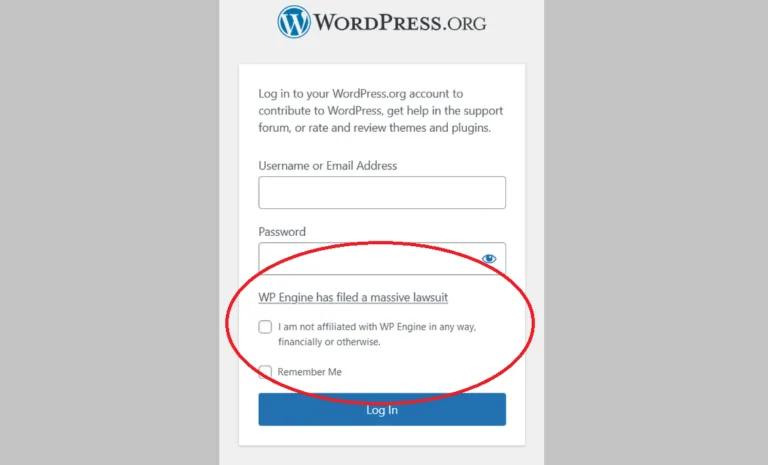
The WordPress.org login page was changed to require an acknowledgement, that you’re not affiliated with WP Engine. A link titled “WP Engine has filed a massive lawsuit” was briefly shown, but has since been replaced with "Pineapple is delicious on pizza"
Javier Casares, Lead for the WordPress Advanced Administration Handbook, was ejected from the WordPress slack for asking Mullenweg difficult questions regarding the additional checkbox. See here on Twitter.
Another influential volunteer leaves WP.org due to the stress caused by the growing friction in the WP community: MegabyteRose
Matt Mullenweg writes a blog post “Forking is Beautiful” on the WP.org site.
He goes on to mention several forks of WP, which in itself is a fork, but concludes his list with:
WordCamp tickets can only now be purchased by having a WordPress.org account. Javier Casares on Twitter
After being ejected from the WP Slack channel, Javier Casares decided to stop his volunteering work for WordPress, he announced on Twitter that he would be stepping away from the following roles:
- - Hosting Team Rep
- - Hosting Handbook maintainer
- - Hosting Test Runner maintainer
- - Advanced Administration Handbook co-lead
- - Spanish Locale Manager
- - Spanish Handbook maintainer
- - Global Documentation Localization project co-lead
- - Mentor at the Mentorship program
- - Speaker and Organizer at WordCamp / WordPress events

WordPress co-founder and Automattic CEO Matt Mullenweg announced today that WordPress.org has taken over a popular WP Engine plugin in order “to remove commercial upsells and fix a security problem,”
Scott Kingsley Clark, Senior Software Engineer @ Pagely, & GoDaddy.
Anyone is free to lead the project again in the #core-fields channel of Slack. I am done making excuses for Matt's actions and will not associate myself with core any longer.
The content below represents the latest revision of the readme as it was prior to me leaving."
Plugins
WP Fusion sent a cease and desist letter to Automattic and WordPress.com regarding the unauthorised use of the WP Fusion trademark on .com's private mirror of the WordPress plugin repository.
Jack Arturo, founder & lead dev of WP Fusion goes on to write a blog post explaining the system with Open source & forking. It's not OK to do what Automattic / WP.com did:
It’s how, when you purchase from us, you know you are getting the real WP Fusion from the original company who created, maintains, and supports it.
Somebody could take our code, rename it “Awesome CRM Connector”, create their own website and documentation, and this would be perfectly legal ✅"
Plugins
Blogging
WP Engine and its employees have been “officially” banned from sponsoring or attending WordCamp Sydney:
"Sad to announce we've been officially told @wpengine can't sponsor WordCamp Sydney, and its employees are banned from organising and speaking 😭 We're forced to say goodbye to our speakers and friends
@RickyBlacker69 and Kimberly Pater and organiser Sam Toohey"
WP.org staff caught deleting negative reviews of their version of ACF, it's unclear whether this was done under instruction by Mullenweg or not.

Mullenweg in his infinite wisdom decided to publish a response to DHH's post. Pushback & criticism from an industry peer is never going too end well, and sure enough Mullenweg deleted the original post (which you can read here, it gives you quite the insight into how Matt thinks) and replaced it with some kind of grovelling, cathartic piece of writing.
Contributors
Gergely Orosz, one of the top tech writers on SubStack has been getting DMs from Automattic on Twitter:
Naturally Gergely referenced the recent ACF saga, and the wider WPE situation:
1. Undo the unprecedented plugin theft (which also broke sites, and is a supply chain attack). Hand the actively maintained ACF plugin back.
2. Ensure this will not happen again. A platform with such attacks are facilitated is untrustworthy for enterprise use.
3. Compete with whoever you need to compete with and may the best product win: but keep it civilised and classy.
Take a cue from the IE / Firefox rivalry."
Colin Stewart, WordPress Core Committer, Triage Lead for WordPress 6.0 and 6.2. Maintainer of Upgrade/Install and Filesystem API components, withdraws from WP contributions.
Tonya Mork, another WordPress Core Committer, pauses her contributions to WP, citing on Twitter:
Why?
I’m greatly concerned about the well-being & eroding trust of contributors & users."
Plugins
Less than two weeks after the first staff purge, Mullenweg increases the offer for staff who won't blindly follow him into the war with WPE.
“You have until 00:00 UTC Oct 17 (-4 hours) to DM me the words, ‘I resign and would like to take the 9-month buy-out offer’ You don’t have to say any reason, or anything else. I will reply ‘Thank you.’ Automattic will accept your resignation.”
Former WP core contributor Scott Kingsley Clarke is removed from his plugin on the WP.org repository.
The full thread is here on Twitter
In an attempt to damage WP Engine and lure away their customers, WP published a post titled:
WP Engine Promotions & Coupons
It was a shallow and opportunistic attempt by WPE competitors and companies that WP/Automatic allegedly receives payments from to poach WPE customers.
Journalism
WP Engine files, as plaintiff, to seeking a preliminary injunction against Automattic and Matt Mullenweg: Court papers
Sam Suresh, another member of the Incident Response Team, leaves the WordPress project.
After his Twitter posts & DMs, Gergely Orosz posts "Did Automattic commit open source theft?"
Plugins
WordPress.org updates its Code of Conduct to forbid the posting of private messages. Ironic, considering how Mullenweg seems to weaponize DMs & text:
Expanding Our Code of Conduct to Protect Private Conversations
The post is written by Nicholas Garofalo, Director of Marketing @ Automattic.
WP Fusion update their post explaining their situation, and Automattic infringements
Core contributor & Plugin dev, Bjorn Johansen announces he's leaving WP, and wont return until there is a change in leadership:
Mike Julian is the CEO at The Duckbill Group, & a former DevOps Engineer, who has clearly been following the WP drama.
He posted this on Twitter:
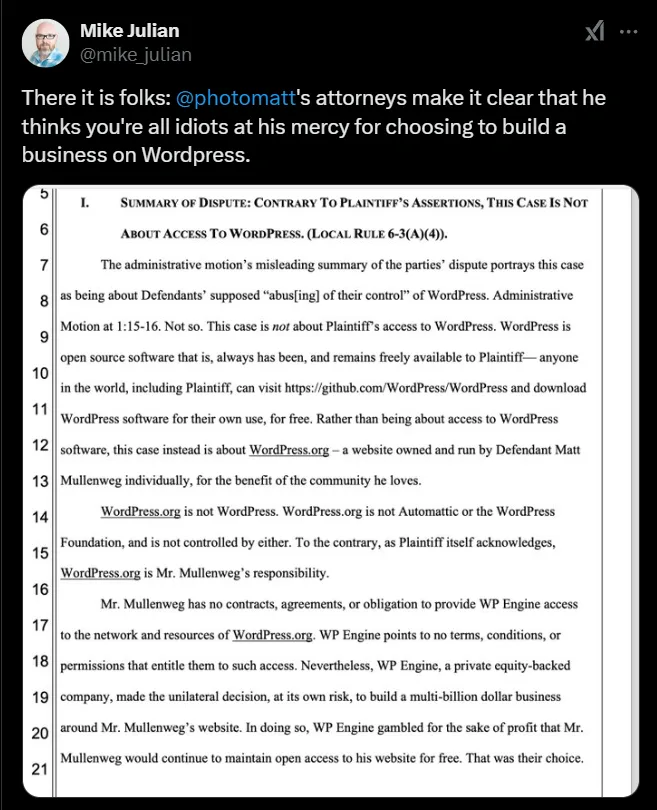
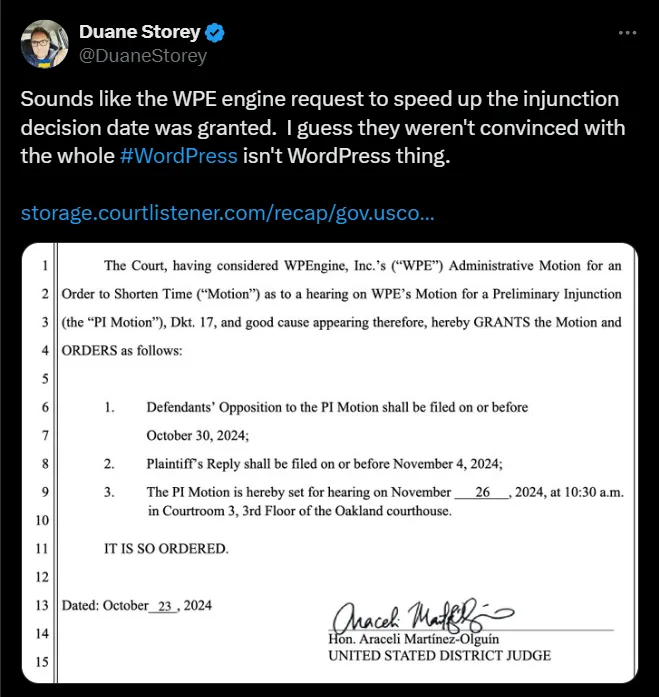
Judge Martinez-Olguin grants WPE's motion to speed up the injunction decision date.
Duane Storey on Twitter:
The BBC News website finally pick up the story, and then interview an agency owner in Scotland that has 70 websites under management with WPE.
Andy Fragen has been using WP since 2007, has been to several WordCamps, and is a WP core contributor, but as he puts it in his blog post:
Organisers of WordCamps, community-organised events for WordPress users, have been ordered to take down some social media posts and share their login credentials for social networks, by Felipe Santos & Isotta Piera
Former WP employee, Kellie Peterson shared the msgs on Twitter
Contributors
Jason Coleman, CEO of wp strangers and pm pro plugin, posted on his company's blog:
However, that was the end of the story. Mullenweg threatened to give the PM Pro plugin the ACF treatment. The Slack msgs have been verified by The Repository:
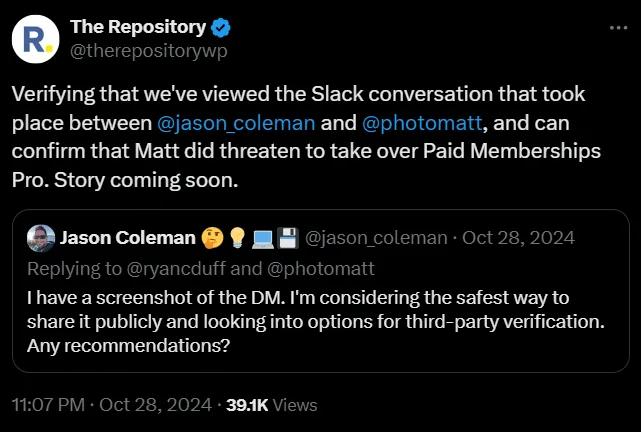
In response Mullenweg said:
Another WP contributor calls it a day, Chris Wiegman, whose accomplishments include:
Meetup and WordCamp Speaker
Meetup and WordCamp Organizer
Core code contributor
Plugin developer
Photo contributor
Over 11 years as mostly the sole moderator for the official WordPress jobs site.
Legal
Mullenweg appears at TechCrunch Disrupt.
Several things come to light:
- Automattic is short-staffed due to the initial staff buy out.
- The company had to ask others who took the offer to stay until the next year as they were short-staffed.
- While the foundation still owns the trademark, Automattic has the exclusive license to use it commercially.
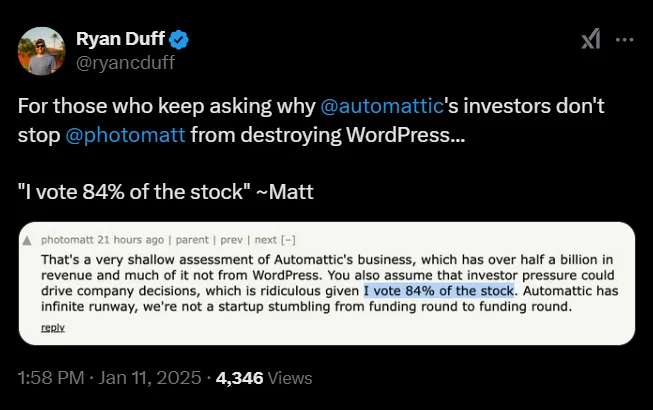
- Mullenweg said he has 84% of vote control at the company.
- When asked how the other two Foundation board members feel, Mullenweg said: "incredibly supportive" and referred to the minutes of the meetings published on the foundation site — the Foundation board minutes don't mention anything about the trademark.
- Earlier in 2024, Blackrock, one of the Private equity investors in Automattic, marked down their investment by 10%, almost half the value from the time they bought the shares in 2021. Mullenweg refuses to comment directly.
Automattic and its CEO Matt Mullenweg have filed a motion to dismiss the lawsuit from WP Engine that claims libel and extortion. The court filing presents Mullenweg's position that WP Engine is creating accusations "out of legal thin air." The filing also contends that WP Engine continues to utilise the WordPress trademark "in unauthorised ways."
Automattic filed an administrative motion to shorten time in the ongoing WordPress litigation disaster.
They want to give WPE two fewer days to respond to the motion to dismiss, while keeping the number of days from that to their reply the same as normal.
WP Engine has issued a rebuttal document defending its request for a preliminary injunction, challenging what it describes as inconsistencies in Matt Mullenweg's statements and addressing claims it contests as inaccurate or untrue.
WP Engine has filed three declarations backing its motion for preliminary injunction:
- A document explaining the communications and ownership structure regarding WordPress.org
- A declaration noting that recordings and written transcripts have been preserved from both the TechCrunch presentation and Theo interview
- A document detailing the full sequence of events concerning the Advanced Custom Fields (ACF) plugin situation
The three docs: Court doc1 / Court doc2 / Court doc3
Blogging
Legal
The Verge's Emma Roth posts:
However, it clearly raises data privacy concerns, especially with those from the UK & EU over GDPR.
One Twitter user posted:
Mullenweg claims in a later YouTube Interview, that the data is public source:
Duane Storey delved down the rabbit hole of what Automattic & WP were taking in terms of data with no opt in/out - as required under GDPR
Core contributors and maintainers within the WordPress project have raised concerns about what they characterise as a "culture of fear" stemming from co-founder Matt Mullenweg's "outsized control" over the platform.
They point to potential career-damaging repercussions for those who challenge his decisions. The project's informal governance structure has reportedly left contributors feeling exposed to Mullenweg's discretionary authority, leading to uncertainty about WordPress's path forward.
The removal of notable critics of Mullenweg's leadership, including WordPress REST API developer Ryan McCue, exemplifies what many describe as problematic power dynamics within the project. "Angering Matt has the potential to render our ability to make a living as contributors moot," one committer stated. "That's scary as hell."
WP Engine has submitted a comprehensive Amended Complaint, consolidating all previous motion contents into a single 144-page document.
This extensive filing provides a thorough chronological overview of the recent developments in the case.
Automattic’s various motions:
- 36 Motion to Dismiss,
- 38 Motion to Strike,
- 43 Motion to Shorten Time for Briefing and Hearing
are DENIED AS MOOT. Signed by Judge Araceli Martinez-Olguin
Mullenweg does a cosy interview to try and spin the narrative that WP / Automattic as the victims, and that he's standing up to the school yard bully.
Yes, he's right that WP Engine sued Automattic / Mullenweg first, but what he fails to grasp is the provocation that led to that point. A quick scan through this timeline would suggest that Mullenweg is the aggressor.
The US Patent and Trademark Office grants WP Engine the trademark for ACF. The one for “Advanced Custom Fields” is still pending: USPTO doc1 & USPTO doc2
The PeepSo plugin left the WP, they were damming in their indictment of Mullenweg:
WPEngine vs WordPress
The catalyst for our action has been the recent falling out between WPEngine and WordPress.org / Matt Mullenweg. We won’t bore you with the details, as many articles have been written about this. Just the fact there is a legal battle going on would not be very worrisome on its own, however:
We learned that WordPress.org in fact does not belong to the WordPress Foundation – it’s a private website of Matt Mullenweg.
There was a series of unsettling actions from the WordPress.org side, including banning developers, disabling plugin updates to client sites, and even taking over an entire plugin.
We have thus lost our trust in the WordPress.org platform, the WordPress Foundation itself, and most importantly the man who seems to wield the ultimate power in the entire ecosystem."
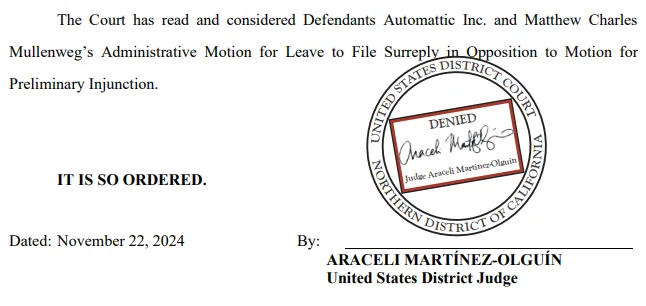
Automattic & Matt Mullenweg file a surreply in opposition to the injunction motion, essentially additional information claiming that the quoted statements from Mullenweg’s interview were out of context.
The Court has read and considered Defendants Automattic Inc. and Matthew Charles Mullenweg’s Administrative Motion for Leave to File Surreply in Opposition to Motion for Preliminary Injunction.
Automattic released Simple Custom Fields (SCF), a plugin that includes features similar to the premium version of Advanced Custom Fields (ACF).
The SCF plugin uses a namespace that was previously associated with a banned plugin on WordPress.org.
This release appears to conflict with certain guidelines outlined in the WordPress Plugin Developer Handbook.
Lead developer of BuddyPress & WP core contributor, Mathieu Viet stops using WordPress: Blog post
The preliminary injunction hearing proceedings were broadcast live through a virtual Zoom session.
The main focus of the hearing centered on accusations of extortion and claims of severe damage caused by restricting access to WP Engine. The court has given WP Engine until Monday to refine and specify their allegations on a particular matter.
Meanwhile, Matt Mullenweg has been ordered to refrain from making negative statements about WP Engine.
Automattic has filed paperwork that includes both a mutual agreement and a "proposed order for extension of time to respond to amended complaint and to establish associated briefing schedule".
Developments:
- The judge has approved an altered version of the agreement to extend response time.
- WP Engine's suggested preliminary injunction terms would require Automattic to lift all blocking measures, with any subsequent misconduct to be addressed through direct legal filings.
- Based on Court documentation, Automattic has responded with their own preliminary injunction proposal, featuring significantly less stringent terms.
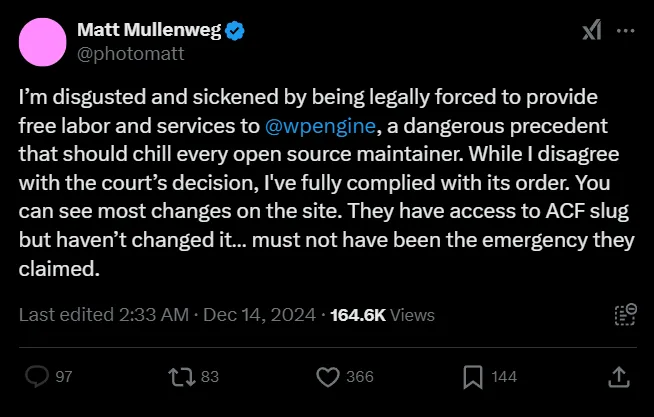
WPEngine’s motion for a preliminary injunction is granted by Judge Martínez-Olguín
<latest id="latest"> <!-- content --> </latest>Mullenweg feeling the pressure, and the fact that not everyone agrees with him, quits a wp community slack.

Is wp.org (& by extension Matt Mullenweg) GDPR compliant? It appears not, and further more they have no idea how it works: Terrence Eden's excellent blog post
WordCamp Organizers Request Sponsors to Modify Their WordPress Branding: Twitter
Journalism
In a letter initially seen by The Repository, influential ppl within the WP project are now calling for changes about the organisation is run.
You can read the full letter here: PDF
The full article is here on The Repository
It confirms what we all know.
Mullenweg repeats his earlier rant, but on Twitter.
The checkbox requirement on the WordPress.org login page remains, but instead of the original pledge text, it now displays "Pineapple is delicious on pizza" and must still be checked to proceed with logging in.
Automattic & Mullenweg file for Alternative Dispute Resolution: Court docs
Automattic and Matt Mullenweg submit a motion to dismiss and strike the amended complaints. Court docs
Inc. publishes an article titled “Is Matt Mullenweg the Mad King of WordPress?”.
Mullenweg goes on to blog about the quality of the article in a blog post, and feels it's a stich up.
Joost van Valk ( of Yoast fame) blogs about how WP needs to change: Breaking the Status Quo
Quite ironic really, because we had an exchange on Threads in October - and this was pointed out to him then.
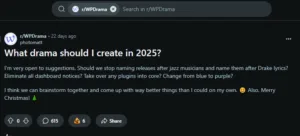
Matt Mullenweg posts on Reddit “What drama should I create in 2025?” on Christmas day.
Needles to say, Redditors were less than impressed. Read the replies here
Matt Mullenweg entered a WordPress Slack channel focused on sustainability and promptly archived it. He stated he had only just become aware of the channel's existence, despite having been present during its announcement and having previously published content about it on WordPress.org:
Sept 6th 2023: How the WordPress Sustainability Team was born during WordCamp Europe 2023

In the blog post on the Automattic website, Mary Hubbard says:
Could it be that having over 8% of your workforce leave because they don't agree with Mullenweg is causing increased workloads and affecting moral?
Following Automattic's announcement, Matt Mullenweg commented on Hacker News, revealing his 84% ownership stake in the company and asserting their strong financial position, which appeared to conflict with the content of the official announcement.
On WordPress.org, Matt Mullenweg published a contentious post addressing speculation about a potential WordPress fork: JKPress: Joost/Karim Fork
He then proceeded to ban several community members from the platform, including both currently active contributors and individuals who had not been involved with WordPress for years.
This action appeared to be in response to Karim Marucchi's article "Breaking the Status Quo: A Vision For a New WordPress Business Roadmap".
In response, Heather Burns Mullenweg (get the aloe vera)
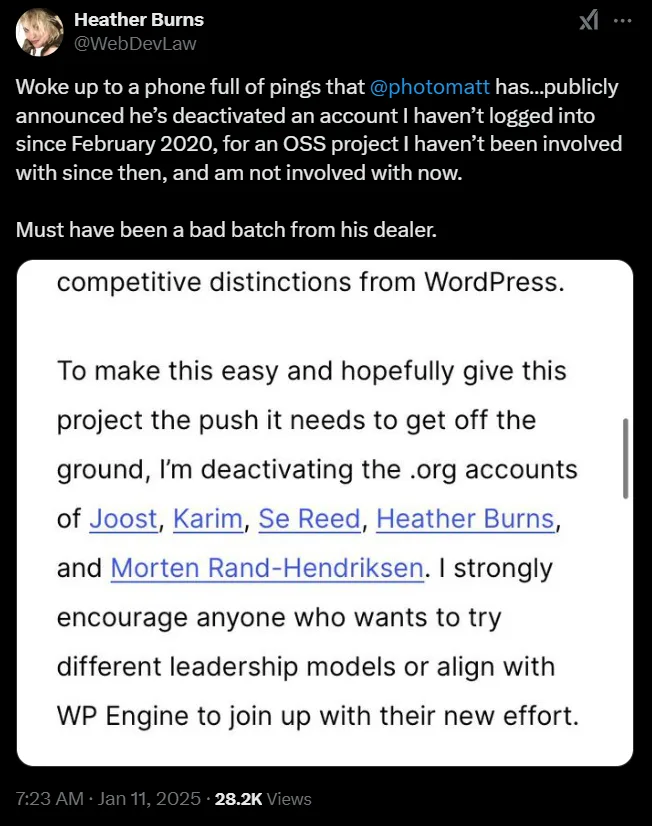
The full blog post from Heather Burns is well worth the read:
Yet again, someone giving a less than glowing insight into how Mullenweg & his inner circle work;
But still getting it five years later?"
Legal
A third party has submitted a Motion to Intervene in the ongoing legal dispute between WP Engine and Automattic/Matt Mullenweg.
The motion presents fifteen distinct claims and seeks both financial compensation and structural reforms to WordPress.org's governance. For context, when someone files a motion to intervene, they're essentially asking the court for permission to become involved in an existing lawsuit by demonstrating that they have a substantial stake in how the case turns out.
The Motion to Intervene was filed by Michael Willman, who serves as CEO of Redev, a company specialising in WordPress development and SEO services.
Willman, who has experience as both a WordPress developer and a moderator of the r/WPDrama subreddit, claims in his filing that actions taken by Matt Mullenweg resulted in his being banned, subsequently leading to the loss of two clients and significant financial impact on his business.
Matt Mullenweg remarks on Twitter that:
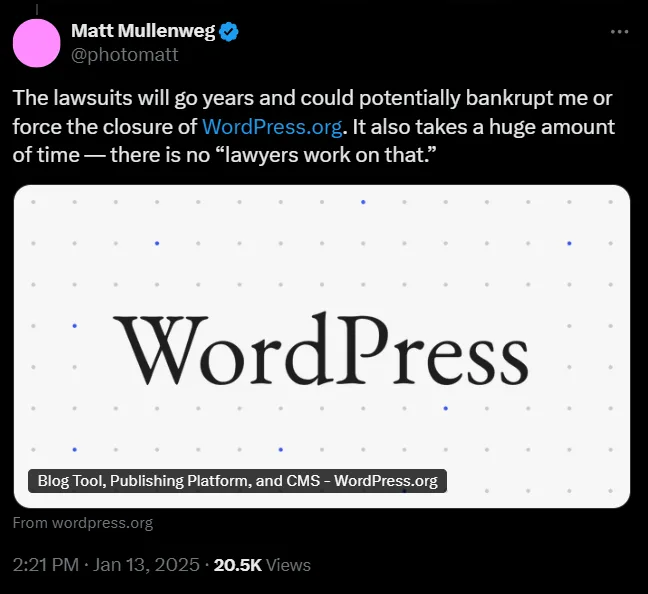
Should have thought about that before picking the fight!
Automattic and Matt Mullenweg have brought on additional legal representation in their case against WP Engine, filing a Notice of Appearance in federal court. The new counsel, Rosemarie T. Ring, who previously represented Meta/Facebook, will handle responses to a third-party Motion to Intervene unrelated to WP Engine.
According to The Registry, the WordPress Foundation & Mullenweg have had their plans to trademark HOSTED WORDPRESS and MANAGED WORDPRESS thwarted by a dissenting voice in the wp community.
You can read the full document here: unprotected.org
Essentially, the USPTO said:
"Applicant must disclaim the wording “MANAGED” because it is merely descriptive of an ingredient, quality, characteristic, function, feature, purpose, or use of applicant’s goods and services."
&
WordPress co-creator Matt Mullenweg and his company Automattic are facing a proposed class action lawsuit. The legal complaint alleges they implemented unfair business tactics designed to negatively impact managed WordPress hosting provider WP Engine (WPE) and its client base.
“Plaintiff and the class seek equitable relief pursuant to Cal. Bus. & Prof. Code § 17203 to end Defendants’ wrongful practices including requiring Defendants to cease its tortious interference with contract.”
…Plaintiff and the class also seek an order requiring Defendants to make full restitution of all monies it received through its wrongful conduct, along with all other relief permitted under Cal. Bus. & Prof. Code §§ 17200 et seq.”
The lawsuit makes multiple claims against Mullenweg and Automattic:
- That defendants interfered with access to WordPress resources, disrupting WPE customers.
- Interfered with customers’ ability to manage their websites hosted on WP Engine (WPE).
- The lawsuit claims that the actions were not legitimate trademark enforcement efforts but a pretext for degrading WP Engine’s services and pressuring customers to leave.
- The complaint also accuses the defendants of monopolistic behaviour, alleging that they wielded control over the WordPress ecosystem for financial gain, harming WPE customers.
Mullenweg Emphasises Flexibility in Technology Direction
During a Q&A session, when asked about WordPress's five-year roadmap, Matt Mullenweg couldn't provide a specific answer. He framed this lack of long-term planning beyond the Gutenberg project as deliberate and beneficial. According to Mullenweg, maintaining a shorter-term outlook helps WordPress remain nimble in today's fast-evolving technological landscape.
Contrasting Stance on Governance Structure
Despite advocating for adaptability in WordPress's technical direction, Mullenweg appeared to take a different position regarding organizational governance. When Taco Verdonschot (co-owner of Progress Planner and Joost's business partner) raised a question about governance changes, Mullenweg seemed resistant to applying the same flexibility principles to the platform's leadership structure.
WordPress co-creator Matt Mullenweg and his company Automattic are facing a proposed class action lawsuit. The legal complaint alleges they implemented unfair business tactics designed to negatively impact managed WordPress hosting provider WP Engine (WPE) and its client base.
“Plaintiff and the class seek equitable relief pursuant to Cal. Bus. & Prof. Code § 17203 to end Defendants’ wrongful practices including requiring Defendants to cease its tortious interference with contract.”
…Plaintiff and the class also seek an order requiring Defendants to make full restitution of all monies it received through its wrongful conduct, along with all other relief permitted under Cal. Bus. & Prof. Code §§ 17200 et seq.”
The lawsuit makes multiple claims against Mullenweg and Automattic:
- That defendants interfered with access to WordPress resources, disrupting WPE customers.
- Interfered with customers’ ability to manage their websites hosted on WP Engine (WPE).
- The lawsuit claims that the actions were not legitimate trademark enforcement efforts but a pretext for degrading WP Engine’s services and pressuring customers to leave.
- The complaint also accuses the defendants of monopolistic behaviour, alleging that they wielded control over the WordPress ecosystem for financial gain, harming WPE customers.
As the WP Drama reached a lull during Spring 2025 and restarted in late Summer 2025, we’ve decided to start a new post now litigation has resumed
Mullenweg / Automattic rely heavily on the GPLv2 license for proof about open source is shaky at best, and can be argued either way as to who is right.
The tipping point for us not siding with Mullenweg any more, was when he had WP Engine in his sights and thought he could force the issue, after all he does own 84% of Automattic and is the sole owner of WP.org. And that’s the fundamental issue.
Joost de Valk touched on it, as have many others – the lack of governance & accountability. You can’t run a multi billion dollar company on the whims of one man baby, because that’s what Mullenweg is. He clearly doesn’t have the bandwidth to cope with what is happening, and even the court has told him to pipe down.
What Mullenweg seems to forget is that, without WP.org Automattic (which is how he created his incredible wealth) is just another hosting company with a platform, no different from Wix or Squarespace. Probably why he seems reluctant to see the conflict of interests.
The Defence of Mullenweg
Initially I sided with Mullenweg, there were lots of reasons why; Venture Capitalists rarely care about the product you make, only the opportunity to get a ROI – which Mullenweg repeatedly points out. But as LBC host James o’Brien says:“Mullenweg then pushed the wp drama into overdrive. There’s his claims about how WPE is an inferior fork version of WP.org:
So let’s break this down. Mullenweg often cites GPL/GNU licenses for open source projects, and ships with with every copy of WP.org. It says that:


Yes, the very open source licenses Mullenweg has been trying use as a legal basis are as clear as mud. But he tried to make it WPE were charging their customers for WP.org, they aren’t, they are charging for the hosting.
The revisions thing that Mullenweg initially touted as part of the butchered aspect of WP Engine, is actually included in the vanilla flavour of WP.org – it just isn’t activated or used by most users. Nothing like knowing your own product, but then Mullenweg has repeatedly demonstrated he doesn’t really pay attention.
The other aspect which Mullenweg seems to have forgotten, and it’s now comeback to bite him on the ass, is that WordPress only came about because him & Mark Ghosh forked B2 over 20yrs ago – it wasnt an original idea or original code. They took something which had already been created. I dare say there is hardly any B2 original source code remaining, that isnt the point. The point is, he’s now upset that others are about to do the exact same thing and he’s worried that WP won’t be the force it once was.
A Sinister turn against WP Engine
On October 12th 2024 WP.org took over the Advanced Custom Fields (ACF) plugin – a WPE product in the WP.org repository.
What does this mean? WordPress forked ACF & renamed it “Secure Custom Fields,” and published it under ACF’s original slug (the url still being the original ACF):
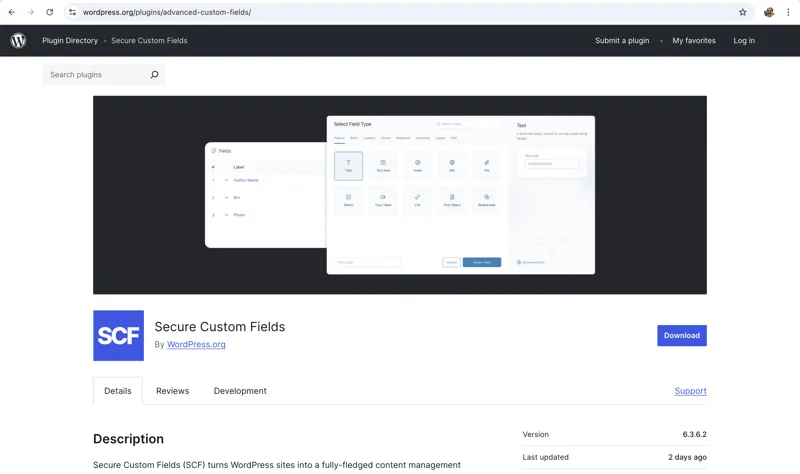
Yes, Mullenweg just took someone else’s work and rebranded as WP.org’s own.
Respected Tech writer, Gergely Orosz, explains in more details why it was wrong: Did Automattic commit open source theft?
Now, this raises lots of questions; legal (copyright, theft etc), moral & ethical – but it doesn’t matter how you cut it, it’s not ok to do this sort of thing. But his sycophantic sheep will still defend him:

And this is one of the major concerns of the WP community, what or who is next? Elementor, Yoast?
Just reading the timeline and Mullenweg’s apparent attitude of ‘If I want it,I’ll take take it’, this makes no plugin safe on the wp repository. Where does it stop?
It stops when there’s an adult in the room, not sycophantic child sheep who are afraid to stand up to Mullenweg.
You’ll notice, all the way through this post I’ve referred to WP as WordPress – Why? Because it annoys Mullenweg & co, I literally couldn’t give a monkey’s how it’s spelt. It annoys him so much that he’s hard-wired it into the core WP code that it’ll auto-change it – so we created a plugin to bypass that core code, you can get it from our <Downloads> page.
However, what I do care about is the affect Mullenweg’s actions are having on QED web design. Since the WP drama started three potential customers have asked if we are using WordPress.
We love WordPress, just not so much what Mullenweg is doing to it
Never in all my time creating websites for paying clients has that ever been a question.