TL;DR: The Anthropic book copyright case is widely misreported. Judge William Alsup ruled in June 2025 that training an AI on legally acquired books was fair use, but that downloading and hoarding over seven million pirated books was not. Anthropic settled the piracy claim for 1.5 billion US dollars, roughly 3,000 dollars per book.
The 1984 and Fahrenheit 451 comparisons do not hold up. Nobody censored or banned anything. Meanwhile UK publishing already pulps a huge share of the books it prints every year, largely unremarked.
This post separates the myths from the ruling, using primary court sources and UK industry figures.
The Anthropic book copyright case has become one of the most misquoted stories in tech, and getting it wrong is easy when the headlines do most of the shouting. At QED Web Design, we spend a lot of time separating genuine signal from social-media noise, whether that is SEO myth or, in this case, a copyright ruling that almost nobody has read.
The short version is simple. A US federal judge found that training an AI on books Anthropic had legally bought was fair use, but that downloading seven million pirated books was not, and the company paid $1.5 billion to settle that piracy claim.
What follows is a plain-English walk through the myths, checked against the court record and, where the social media driven faux outrage turns to book “destruction”, against what the UK publishing industry already does every single year.
What did the Anthropic book copyright ruling actually say?
The Anthropic book copyright ruling split the case cleanly in two: training was lawful, piracy was not. In June 2025, US District Judge William Alsup ruled on summary judgment in Bartz v. Anthropic that using legally acquired books to train the Claude large language model was “quintessentially transformative” and protected as fair use under Section 107 of the US Copyright Act.
The second half of the ruling is the half the headlines tend to drop. Alsup held that Anthropic’s downloading and permanent storage of pirated books from shadow libraries such as Library Genesis and Pirate Library Mirror was not fair use, and looked like straightforward infringement. As reported by NPR and Reuters, the judge wrote that Anthropic had no entitlement to build a central library out of pirated copies, and that later buying some of those titles did not wipe out the original wrong.
That piracy exposure is what drove the settlement. Rather than take the piracy claim to a damages trial, Anthropic agreed in 2025 to pay $1.5 billion, which works out at roughly $3,000 per book across an estimated 500,000 covered titles.
Final approval came in July 2026. So the accurate one-line summary is this: The training was cleared, the piracy was paid for.
The distinction between how the data was obtained and what was done with it runs through everything below. Keep it in mind for the next myth, which leans heavily on ignoring it.
Is the Anthropic case really like Orwell’s 1984 or Bradbury’s Fahrenheit 451?
No. The comparison to 1984 and Fahrenheit 451 is emotionally satisfying and factually empty.
Both novels are about state power destroying ideas: Orwell’s Ministry of Truth rewrites history and erases inconvenient facts, while Bradbury’s firemen burn books to stop people thinking. Neither maps onto a copyright dispute about how a private company sourced training data.
The core of both books is suppression of knowledge. In the Anthropic book copyright case, no idea was censored, no title was banned, and no reader lost access to anything. Every book involved remains in print, in libraries, and on shelves. A model learning statistical patterns from text is close to the opposite of a regime deleting text so nobody can read it. If anything, the technology makes the contents of books more findable, not less.
There is a fair criticism buried under the bad metaphor, and it deserves stating plainly rather than dressing up in dystopian costume.
Authors argued that Anthropic sought to profit from their work without permission or payment, and on the piracy point the court agreed and the company paid. That is a real grievance about consent and compensation. It is not thought control, and reaching for Orwell or Bradbury actually weakens the genuine argument by making it sound hysterical.
The book-burning image gets its real power from the idea that physical books were destroyed. That part is not invented, so it is worth looking at honestly, alongside what the publishing industry already does with books every year.
Did Anthropic “destroy books”, and how many does the UK pulp anyway?
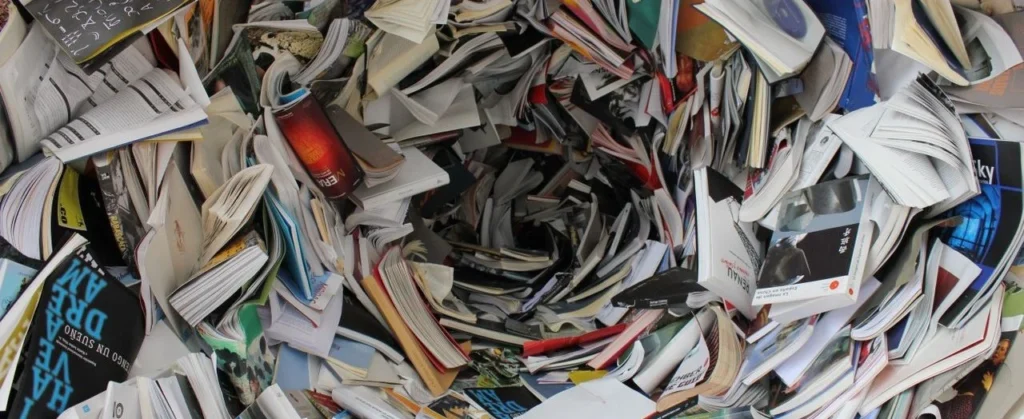
Anthropic did physically destroy books, and the scale is real, but the framing still matters. To build a searchable digital library, Anthropic ran an internal operation it codenamed Project Panama, revealed through court filings unsealed in January 2026 and reported by the Washington Post.
Vendor proposals referenced converting between 500,000 and two million books over six months. The process was industrial: a hydraulic cutter removed the spines, high-speed scanners captured every page, and the paper was then pulped & recyled. Judge Alsup found this scan-and-discard method, applied to lawfully purchased books, fell within fair use, on the reasoning that each physical copy was simply replaced by a single digital one under the first-sale doctrine.
There is a genuine concern here that deserves stating without exaggeration. Follow-up reporting by 404 Media in July 2026 found that a market has grown up around sourcing physical books for AI training in bulk, often through brokers using confidentiality agreements, drawing on second-hand, overseas and foreign-language stock rather than fresh in-print copies.
One bookseller told 404 Media they had mixed feelings, welcoming the clear-out of unsellable inventory but disliking that:
“uncommon books are being pulped”.
The worry that an out-of-print title with few surviving copies could go through a cutter is legitimate. What has not been shown, as a media fact-check by MLQ News noted in July 2026, is a single verified rare title that an AI company bought and destroyed. The concern is real; the proof of catastrophic loss is not yet on the record.
Here is the context almost nobody supplies, and it is worth putting in real numbers rather than percentages. The UK buys roughly 200 million print books a year, going by Nielsen BookScan’s tracked sales.
On top of that figure, the trade ships far more copies to shops than it ever sells, and the unsold ones come back. Industry analysis puts average returns at around 20 to 25% of the copies distributed, with mass-market paperbacks reported as high as 48%.
Put plainly, for every hundred books that sell, another twenty-five to thirty-five are printed, shipped, and sent straight back.
That works out at somewhere between 40 and 65 million returned books in the UK every year, and a large share of those are pulped rather than resold, because warehousing them costs more than destroying them. To put that side by side with the case at hand: even the low end of that annual pulping, 40 million books, is between twenty and eighty times the entire 500,000 to two million that Anthropic scanned across its whole Project Panama operation. The routine, unremarked destruction dwarfs the thing people are furious about.
This is not a fringe practice. Amazon alone was shown by an ITV News investigation to be marking well over 100,000 items a week for destruction in a single UK warehouse, books among them. Much of the outrage, then, is in the selective framing. Quietly pulping a quarter of a print run for warehouse economics passes without comment, while scanning bought books to make their contents searchable gets compared to totalitarian censorship.
The out-of-print worry is worth taking seriously, but it applies just as much to the routine pulping the industry already does, and that half of the ledger rarely gets a headline.
None of this means the copyright concern is fake. It means the specific “they destroyed books” line proves far less than it appears to, which brings us to the biggest legal misreading of all.
Did the judge rule that AI training is copyright infringement?
No, the judge ruled close to the opposite on training, and that misreading is the most consequential myth in circulation. On the specific question of using copyrighted books to train an AI model, Judge Alsup sided with Anthropic, finding the training use transformative and protected as fair use. The infringement finding was about piracy, meaning the downloading and hoarding of stolen copies, not about the act of training itself.
Fair use is a US legal doctrine, decided case by case, that can permit copying without permission depending on factors such as the purpose of the use and its effect on the market for the original. Because it is fact-specific, this ruling does not make all AI training automatically legal everywhere.
Two further limits matter for anyone quoting it. First, because Anthropic settled rather than letting the case reach an appeals court, the fair-use ruling is a single district-court decision and never became binding precedent. Second, this is US law, and international copyright treaties do not turn it into a global verdict.
That treaty point is worth spelling out, because it is where the argument usually gets muddled. Under the Berne Convention, which both the US and the UK have signed, a UK author’s work is automatically protected in the United States to the same standard a US author’s work receives. That principle, known as national treatment, is why British writers were covered by the class action and could claim against Anthropic in a US court. What Berne does not do is export any one country’s exceptions. It runs on territoriality: the governing law is the law of the country where the use takes place, not the author’s home law. Anthropic’s scanning and training happened in the United States, so US fair use governed whether those acts were lawful.
The practical consequence for a British business is the opposite of reassuring.
The UK has no broad fair-use defence of its own. It has narrow, purpose-specific exceptions, plus a text-and-data-mining exception currently limited to non-commercial research, and the scope of that exception is exactly what the live UK government consultation on AI and copyright is contesting as of 2026. There is no equivalent doctrine for a US fair-use finding to carry across, so the same conduct judged in a UK court would start from a very different place.
The table below lays out what the case did and did not decide, because the gap between the two is exactly where the myths breed.
The honest summary needs both halves held together at once: the training method was cleared, and the sourcing was punished. Drop either half and you get one of the two competing myths. Two narrower legal misreadings tend to attach themselves to this case as well, and they are worth clearing up next.
What do people get wrong about first sale and distribution?
Two legal myths cling to the Anthropic copyright case: that the first-sale doctrine did the heavy lifting, and that copyright is only infringed when you distribute a copy. Both are wrong, and both matter if you want to argue the case accurately rather than repeat a talking point.
Start with first sale. The first-sale doctrine, codified in Section 109 of the US Copyright Act, means that once you lawfully buy a copy of a work, you own that physical object and can resell it, lend it, or destroy it without the copyright holder’s permission.
That is a real principle, and it is why Anthropic was entitled to shred the print books it had actually bought. What first sale does not do is authorise reproduction. Making a digital scan creates a new copy, and first sale governs the object, not the right to copy it. So the scanning still had to clear the fair-use test, and it did so in Alsup’s ruling only because it was a one-for-one replacement: buy the print, make one digital copy, destroy the print, with no net increase in copies.
First sale supported the destruction; fair use, not first sale, is what actually cleared the scan.
Now the bigger one: the claim that “it is only infringement if you distribute it”.

Reproduction is a separate exclusive right in its own terms, distinct from distribution, under both US and UK copyright law.
You can infringe by copying alone, without ever handing a copy to anyone. Private home copying survives on specific fair-dealing and personal-use carve-outs, not because distribution is the trigger for infringement.
Applied to this case, Anthropic’s problem with the pirated books was never that it distributed them, because it did not. The problem was that downloading and storing more than seven million pirated copies was unlawful reproduction and retention in itself.
Anyone arguing “no distribution, no infringement” has simply misstated the law and doesn’t understand it.
So why is ripping a bought DVD illegal but scanning a bought book was not?

Because a DVD has an encryption lock and a book does not, and breaking that lock is a separate offence from copying. A common version of the hypocrisy argument runs like this: if you buy a DVD and digitise it that is copyright infringement, so how can an AI firm buy a book, scan it, and walk away clean?
It feels like one rule for corporations and another for everyone else. The premise is half right, but the reason it is right has nothing to do with copying.
Ripping a commercial DVD is generally unlawful because of anti-circumvention law, not the reproduction right. Commercial DVDs are protected by encryption, usually the Content Scramble System, and the illegal act is breaking that protection.
In US law this is Section 1201 of the Digital Millennium Copyright Act. In the UK it is the technological protection measures regime in sections 296ZA to 296ZF of the Copyright, Designs and Patents Act 1988. UK government guidance states plainly that copyright owners may use these measures, such as encryption on DVDs, and that circumventing them is illegal.
When the UK briefly introduced a private-copying exception in 2014, effective protection measures stayed separately protected, so breaking the lock remained unlawful even for a copy you were otherwise allowed to make.
A printed book carries no such lock, so there is nothing to circumvent when you scan it. That is the whole difference.
Anthropic was not cracking encryption; it was photographing pages of an unprotected object it owned
- The DVD comparison breaks on a barrier the book simply does not have.
- It breaks a second time on the point from the first-sale discussion above
The DVD-ripper typically keeps the disc and the digital copy, whereas Anthropic’s scan was cleared only because it destroyed the print and kept one digital copy in its place. Two copies from one purchase is a different act from one copy replacing another.
Getting these two points right changes how you read every other AI copyright story, which is where the last section comes in.
Why does getting the Anthropic copyright story right matter?
Getting the Anthropic copyright story right matters because bad framing crowds out the real questions a business or creator should be asking. When a genuine issue about consent and payment gets dressed up as 1984, the debate turns into a shouting match about censorship that never happened, and the practical questions go unanswered. Those questions are the useful ones: how should training data be sourced, who gets paid, and what does UK law actually permit.
This is the same discipline we apply to digital myths every day at QED Web Design. Our editorial approach is evidence-first and practitioner-led, and we have written before on how viral claims about AI, from data-centre water use to inflated SEO statistics, tend to fall apart once you check them against primary sources. A copyright ruling is no different: read the ruling, separate the two findings, and the panic quietly deflates.
There is a limitation worth naming. None of this is legal advice, and QED is a web design and SEO agency, not a law firm. US fair-use outcomes do not transfer to UK copyright, and the UK’s own rules on AI and text-and-data mining are still being debated, so a British author or business should take proper legal advice on their own position rather than lean on a headline about a Californian case.
If you want content that treats your customers as intelligent and checks its facts, rather than chasing outrage, that is the kind of writing we do.
Sources
- NPR, “Anthropic settles with authors in first-of-its-kind AI copyright infringement lawsuit“, 2025
- Reuters (via Yahoo), “Anthropic wins key US ruling on AI training in authors’ copyright lawsuit“, 2025
- MarketBeat / Associated Press, “Judge rules AI company Anthropic didn’t break copyright law but must face trial over pirated books“, 2025
- The Authors Guild, “Bartz v. Anthropic Settlement: What Authors Need to Know”, updated 2026
- TechCrunch, “Anthropic’s landmark $1.5B copyright settlement is approved”, 2026
- Tech Times, “Anthropic Copyright Settlement Gets Final Approval: $3,000 Per Book, No Binding Precedent”, 2026
- Kluwer Copyright Blog (Wolters Kluwer), “The Bartz v. Anthropic Settlement: Understanding America’s Largest Copyright Settlement”, 2026
- International Publishers Association, “Are book returns essential to the book business or is it time to rethink?”, 2023
- Ingenium Books, “Explaining Book Retailer Returns in the Publishing Industry”, 2024
- The Bookseller, “Amazon destroying millions of items of unsold stock, including books galore“, (ITV News investigation)
- Statista, “UK book industry, statistics and facts”, 2024
- Nielsen BookScan UK, print book sales volume data (approximately 200 million print books sold per year), 2022 to 2025
- The Washington Post, reporting on Anthropic’s “Project Panama” book-scanning operation, 2026 (as cited by Novara Media and others)
- 404 Media, “AI Companies Are Buying Tons of Old Books Because They’re Free of AI Slop”, 2026
- Novara Media, “AI Firms Are Buying up Old Books, Then Scanning and Destroying Them”, 2026
- MLQ News, “What the Evidence Actually Shows About AI Companies Destroying Books”, 2026
- GOV.UK Intellectual Property Office, “Technological Protection Measures (TPMs) complaints process”, 2021
- Copyright, Designs and Patents Act 1988, sections 296ZA to 296ZF (legislation.gov.uk)
- LegalClarity, “Is Ripping DVDs Illegal? DMCA Rules and Penalties”, 2026