What is sustainable web design?

sustainable website scroll down

TL;DR:

Recently QED attended a networking event, and the most common question was:

What is sustainable web design ?

So, here we go, a post explaining it, and why it’s important. The planet needs it, your customers want it and it could save you money in the process.

Table of Contents

1. What is sustainable website design ?

  • What is Sustainable Web Design Key Principles?
  • Why does it matter?
  • The UK Context

2. The Key Principles of Sustainable Web Design

  1. Efficiency
  2. Renewable Hosting
  3. Longevity
  4. Accessibility and Usability
  5. Ethical Content Choices
  6. Colour Palettes Matter
  • Practical Examples Case Studies: Heavy vs Lean Websites

3. Measure The Impact Your Site Has

  • User Experience
  • Brand Trust
  • Cost Savings

4. Challenges and Trade-offs

5. Getting Started: A UK Checklist

6. Future-Proofing Your SEO Strategy

  • Industry Implications

7. Sources


What is Sustainable Website Design ?

When most people think of sustainability, they picture wind farms, electric cars, or reusable coffee cups. Few stop to consider the environmental impact of the internet, but the truth is that every search, email, ai prompt, and website visit consumes energy.

Data centres, networks, and personal devices all require electricity, and that electricity often comes from fossil fuels. The digital world is not as weightless as it seems.

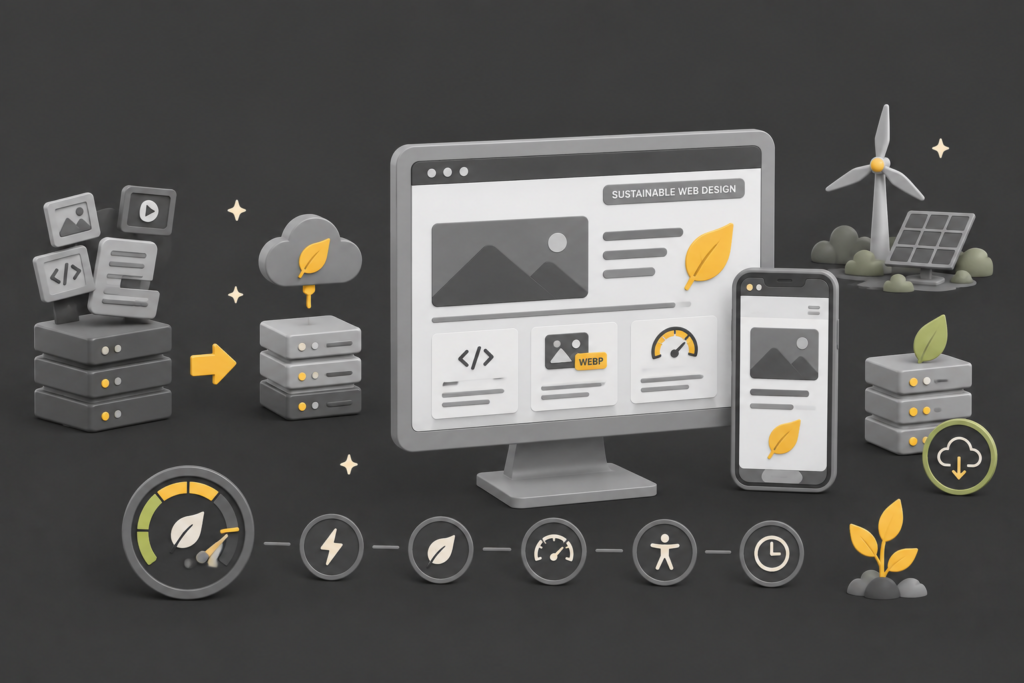
This is where sustainable website design comes in. It is an approach to building digital experiences that minimise energy use, reduce unnecessary waste, and last longer, all while still delivering beautiful, functional, and effective results for businesses and users.

In the same way that architecture has embraced energy efficiency, or product design has shifted towards recyclable materials, web design is undergoing its own green transformation.

What is Sustainable Web Design Key Principles?

Sustainable website design is the practice of creating websites that are efficient, long-lasting, and environmentally responsible. In simple terms, it means building sites that do more with less — fewer resources, fewer emissions, and less waste — while still providing an excellent user experience.

The idea gained momentum in 2019 with the publication of the Sustainable Web Manifesto, a pledge signed by designers and developers worldwide (QED is a signatory). It outlined six key principles: clean, efficient, open, honest, regenerative, and resilient. These values echo broader trends in design and business, where sustainability has shifted from a nice-to-have to a fundamental expectation.

Much like energy-efficient homes or hybrid cars, sustainable websites don’t look radically different on the surface. The difference is in what happens under the bonnet: optimised images, streamlined code, efficient hosting, and thoughtful choices that cut unnecessary waste.

Why Does It Matter?

The internet’s carbon footprint is significant and growing. The Carbon Trust estimates that the digital sector contributes between 2–4% of global greenhouse gas emissions, a figure higher than aviation. And unlike aviation, internet usage is rising rapidly year on year.

The UK Context

Britain is one of the most digitally active nations in Europe. According to Ofcom, the average UK adult spends over four hours online every day, much of it on mobile devices. Add in e-commerce, streaming, and remote working, and the demand on servers and networks is staggering. Every web page loaded requires power not only at the user’s end but also in the transmission and storage of that data.

A simple analogy helps: imagine every time someone visits a website, they are taking a car journey. A small, efficient site might be like a quick trip in an electric hatchback. A heavy, bloated site could be compared to driving a gas-guzzling SUV on the same journey. Both get you there, but one consumes far more resources than the other.

The case in point is when Sky decided to do promoted posts on LinkedIn, but failed to spot that their own website has the same carbon footprint as 134 average cars doing 10,000 miles each a year – Are they even asking themselves; What is sustainable web design?


The Key Principles of Sustainable Web Design

1. Efficiency

The most sustainable websites are also the leanest. Efficiency means reducing the weight of a site by cutting oversized images, minimising scripts, and removing bloat. A smaller site loads faster, performs better, and uses less energy in transmission.

2. Renewable Hosting

Where a website lives makes a difference. Many UK hosting providers now power their servers with renewable energy or purchase carbon offsets. Choosing a provider listed in the Green Web Foundation directory (like us)
is one of the simplest ways to reduce digital emissions.

3. Longevity

Too many websites are built with short-term thinking. A sustainable site is designed to last: flexible enough to evolve with the business, easy to update without a complete rebuild, and built on stable technology. The longer a site lasts, the fewer resources are wasted on constant redesigns.

4. Accessibility and Usability

A truly sustainable web is inclusive. If a site is simple to navigate, fast to load, and compatible with assistive technologies, it reduces wasted effort and serves more people with less friction. Accessibility overlaps strongly with sustainability, because a cleaner, more efficient design is usually easier to use.

5. Ethical Content Choices

Not every shiny feature belongs on a website. Autoplay videos, intrusive tracking scripts, and energy-intensive animations add little value for users but consume significant resources. Making conscious choices about what is genuinely needed is part of ethical, sustainable design.

6. Colour Palettes Matter

It would be obvious to most people that using White as opposed to Black would use more energy, but by how much? According to research by Google for their OLED phone screens, 23% more. But it’s not just white that uses more energy, using Blue instead of Red uses more, and so on.

But don’t think using ‘Dark’ mode will reduce your energy consumption either. The BBC has found that instead of reaping the energy savings, the majority of users just increase brightness, mitigation any energy saving.

Practical Examples
Case Study: Heavy vs Lean websites

Consider two online shops selling the same product. One is loaded with autoplay videos, oversized images, and complex scripts. The other uses compressed images, simple animations, and a streamlined checkout process.

The heavy site may require 5 MB per page load. If 10,000 people visit in a month, that equals 50 GB of data transferred.

The leaner site might only use 1 MB per load. The same 10,000 visits would consume 10 GB.

That is a fivefold difference in energy usage, bandwidth costs, and carbon footprint — all for delivering the same product.

To see a real world case study, visit our post on Green Michelin Star Restaurants in 2025


Measuring The Impact Your Site Has

There are now simple tools to measure a website’s environmental impact:

These tools give practical scores and suggestions for reducing digital waste.

  • Benefits for Businesses
  • SEO and Performance

Fast, efficient websites consistently perform better in Google search results. Page speed is a known ranking factor, and Google has made clear that sites providing better user experience will rank more strongly.

User Experience

Visitors are impatient. Studies show that if a page takes longer than three seconds to load, many people will leave. Sustainable sites are often faster and smoother, which improves engagement, conversions, and customer satisfaction.

Brand Trust

Sustainability is a selling point. A 2023 Deloitte UK report found that over half of British consumers have changed their lifestyle to be more sustainable, and many are actively seeking eco-friendly brands. A greener website signals commitment and builds trust.

Cost Savings

A leaner site requires less hosting bandwidth and fewer server resources, which translates into lower monthly bills. Longer-lasting sites also reduce the need for costly rebuilds every couple of years.


Challenges and Trade-offs

When you start out asking yourself as a web designer; “What is Sustainable Web Design?”, then you realise it is not without its difficulties, and practical implications.

Creative ambition vs efficiency: Designers often want high-resolution video backgrounds or complex animations, which can conflict with sustainability goals.

Greenwashing risks: Not all hosting companies claiming to be “green” are transparent about their energy sourcing. Verification is essential.

Client expectations: Some clients equate visual complexity with value. It takes education to show that simplicity can be both elegant and effective.

Balancing these trade-offs is part of the job of a responsible designer.


Getting Started: A UK Checklist

If you are planning a new site or considering improvements, here are practical steps tailored to UK businesses:

  • Audit your current site with Website Carbon Calculator, Ecograder, or EcoPing.
  • Optimise images and files before uploading. Use formats like WebP and compress everything.
  • Review your hosting provider. Switch to one listed in the Green Web Foundation directory.
  • Check accessibility using tools such as WAVE or AXE.
  • Streamline content. Remove unnecessary pages, scripts, or plugins.
  • Plan for longevity. Use a flexible CMS like WordPress that can evolve rather than requiring constant rebuilds.
  • Educate your team. Make sustainability part of your internal content and design practices.
 

Conclusion

Sustainable website design is not just a buzzword. It is a practical, necessary response to the growing environmental impact of our digital lives. By focusing on efficiency, renewable hosting, accessibility, and ethical choices, businesses can create websites that are better for people, the planet, and their own bottom line.

The good news is that every site, no matter how small, can make improvements. Whether through lighter images, greener hosting, or simply rethinking design priorities, the web can become a more sustainable space one site at a time.

If you are ready to take the first step, audit your website today or start a conversation about a greener redesign. The future of the internet will be lighter, faster, and more sustainable — and your business can be part of that change.


Sources

What is sustainable web design

To see the effect of our
content creation,
See our case study
on The SV Group

We created content over a six month period targeting key areas where their business wanted to expand