TL;DR: A DIY website builder is the right call when you need a cheap, simple presence quickly and your site does not have to win business.
The moment your website becomes a real source of leads, sales, or credibility, professional design starts to pay for itself, usually faster than people expect.
This guide walks through the honest trade-offs, the real UK costs on both sides, and the clear signals that tell you it is time to hire a professional.
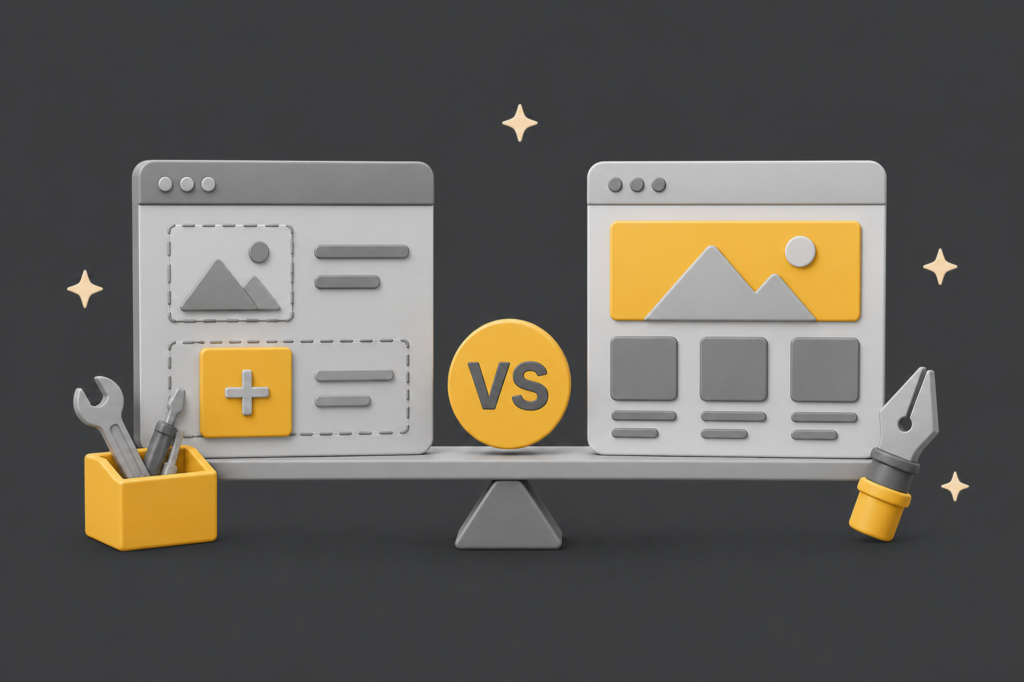
Having a website is no longer the question. The question is who should build it, and that is where most small business owners and Tradesmen get stuck. On one side there is the appeal of a DIY builder: cheap, quick, no developer needed. On the other there is professional design, which costs more upfront but is built to do a job.
This is not really a money decision dressed up as a strategy decision. It is the other way round. The right answer depends on what you need your website to do, and we will work through that honestly, including the times when DIY genuinely is the better choice.
What DIY website builders are actually good at
Builders like Wix, Squarespace, and WordPress.com have changed who gets to have a website. You no longer need to know any code to put something live, and that is a genuinely good thing. For the right situation, a DIY builder is the sensible choice, not a compromise.
Here is where they earn their place:
- Personal projects, portfolios, and hobby sites
- Very early-stage businesses testing an idea before committing real budget
- Temporary or placeholder sites that just need to exist
- Businesses on an extremely tight budget where any site beats no site
The cost is the obvious draw. Most builders run between £10 and £50 per month when billed annually, you get drag-and-drop editing, and you can be live in a day. According to Clutch, 46% of small businesses without a website point to cost as the main reason, and builders answer that directly.
The trade-offs only start to bite when the site needs to do more than exist. Customisation is limited, control over on-page SEO is patchy, and the templates mean your site can look like hundreds of others using the same one. None of that matters for a hobby blog. All of it matters the moment you are relying on the site to bring in work.
What you are really paying for with professional design
The biggest misconception about professional website design is that you are paying for it to look nicer. Looks are part of it, but they are not the point. You are paying for a site that is built to perform: to be found, to load fast, to guide a visitor towards getting in touch, and to keep working as your business grows.
In practice, professional design means:
- A structure built around your business goals, not a template’s assumptions
- Branding that sets you apart instead of blending in
- A layout designed to turn visitors into enquiries
- Proper search engine optimisation built in from the start, not bolted on later
- Genuine mobile responsiveness across every device
- Accessibility and security handled as standard
The numbers behind first impressions are worth knowing. Nielsen Norman Group found people form an opinion of a website in around 50 milliseconds, and Stanford’s Web Credibility research found 75% of users judge a company’s credibility on its website design. Your site is often the first impression you make, and it gets made in half a second.
There is a hidden cost on the DIY side that gets left out of every comparison: your time. If you are a sole trader who would otherwise be billing at £30 an hour, and you spend forty hours wrestling with your own site, that is £1,200 of lost earnings before you have even weighed up the quality gap. Time spent fighting a website builder is time not spent running your business.
DIY vs professional: the real UK costs
Here is how the two stack up on cost, using real UK figures rather than vague ranges. The headline price is only half the story, so this also accounts for the things people forget to budget for.
| DIY website builder | Professional design | |
|---|---|---|
| Upfront cost | £10 to £50 per month | £500 to £6,000, builds from £1,800 |
| Time to launch | Within a day | Two to four weeks |
| Your own time cost | High, you build it | Low, handled for you |
| On-page SEO control | Limited | Built in from the start |
| Performance and speed | Template-dependent | Optimised |
| Custom functionality | Restricted | Bespoke |
| Scales as you grow | Hits a ceiling | Grows with you |
| Two-year total cost | £240 to £1,200, plus add-ons and your time | Build plus £100 to £300 per year running costs |
| Best for | Hobby sites, tests, tight budgets | Sites that must win business |
The figures above line up with the wider market. For a full breakdown of what small business websites cost across every tier, from DIY through to bespoke builds, our guide to website design costs in the UK sets out the real numbers and the ongoing costs most people miss.
The thing the cost comparison cannot show is the cost of getting it wrong. Rebuilding a poorly built site within eighteen months is one of the most common and most avoidable expenses we see. The cheapest quote is almost never the cheapest option once you count the rebuild.
Five signs it is time to hire a professional
If you are on the fence, these are the signals that tip the decision towards professional help. You do not need all five. Even one or two is usually enough.
1. Your business relies on its online presence
If your website is a primary source of leads or sales, the quality of it directly affects your bottom line. HubSpot found 38% of users stop engaging with a site if the layout is unattractive. When the site is doing real commercial work, that lost engagement is lost income.
2. You need specific functionality
Booking systems, member areas, e-commerce, or integration with your other tools rarely work well on a builder. These need proper implementation to run smoothly, and they are exactly the sort of thing that pushes a build into custom territory.
3. Your site needs to load quickly
Google research shows that as load time climbs from one to three seconds, the chance of a visitor bouncing rises by 32%. Speed is where builders often struggle and where professional optimisation makes a measurable difference.
4. You are up against strong competition
In a crowded market, a sharp website is how you stand out. If your competitors look polished and you do not, the comparison is being made for you, and not in your favour.
5. You are short on time or technical confidence
A website needs ongoing attention: updates, backups, security. WordPress maintenance is straightforward to hand over, and the hours you would spend struggling with it are almost always better spent on the work that actually pays you.
You do not have to choose just one
The decision is not always all or nothing. Plenty of businesses take a sensible middle path, and it is worth knowing those options exist before you commit either way.
- Start DIY, plan for growth. Launch a simple builder site now, with a clear intention to move to a professional build once the business is established.
- Bring in a professional to improve what you have. Many designers can work with an existing site rather than starting from scratch.
- Pay for consultation, not a full build. Even a few hours of professional input on strategy and structure can save you from the common, costly mistakes.
For some very early-stage businesses, even a Facebook page versus a proper website is a fair question to ask before spending anything at all. The point is to match the spend to where the business actually is, not where you hope it will be.
How to make the call for your business
Strip away the statistics and the decision comes down to a handful of honest questions. Run through these before you spend anything:
- What job does my website actually need to do: generate leads, sell, build credibility, take bookings?
- What first impression do I need to make, and how does my current or planned site measure up?
- How much time can I realistically give to building and maintaining it myself?
- What functionality does the business genuinely require, now and in the next year or two?
- What is my budget across both the build and the ongoing running costs?
If the answers point to a site that needs to win business, look professional, and grow with you, then professional design is the better investment, and it tends to repay itself sooner than people assume. If the answers point to a simple presence for a hobby or an idea you are still testing, a builder is the smart, frugal choice and there is nothing wrong with that.
Either way, the worst decision is the one made on price alone without asking what the site is for. Get that clear first and the right route usually picks itself.
If you would like a straight answer about which side of the line your business sits on, we offer a free, no-pressure website review. Get in touch with QED and we will tell you honestly whether you need us or not, because pointing you towards a professional build you do not need would not be much of a recommendation.
Sources
- Stanford Web Credibility Research, credibility.stanford.edu: 75% of users judge a company’s credibility on its website design.
- Google mobile page speed benchmarks, Think with Google: bounce probability rises 32% as load time goes from one to three seconds.
- Nielsen Norman Group, nngroup.com: users form an opinion of a website in around 50 milliseconds.
- Clutch small business survey, clutch.co: 46% of small businesses without a website cite cost as the main reason.
- HubSpot Research, blog.hubspot.com: 38% of users stop engaging with a site if the layout is unattractive.
- UK website pricing and ongoing costs: QED Web Design, Website Design Cost UK, 2026.
For a no-commitment conversation about your options and how QED web design can help your business.