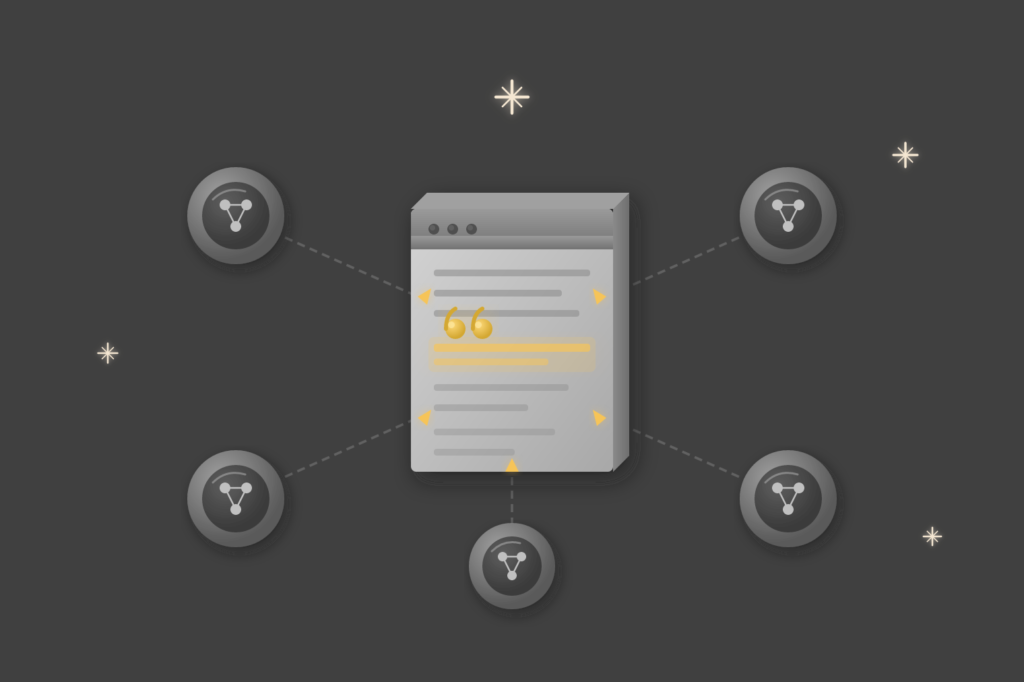
What makes a URL more likely to appear in LLM citations?
A URL is more likely to be cited by large language models when it contains specific, verifiable facts presented in short, self-contained passages that can be extracted without needing surrounding context.
Research from Search Engine Land (November 2025), based on an audit of 15 domains generating nearly 2 million organic sessions and 7,500 direct ChatGPT referral sessions, found that the single strongest predictor of ChatGPT citation was the presence of “answer capsules”: short, self-contained answer blocks near the top of a section that state a fact or answer a question without relying on surrounding text.
The second strongest predictor was the inclusion of original or proprietary data. Pages that contained a unique statistic, a branded finding, or first-party research were cited at significantly higher rates than pages offering only general advice.
Other factors that increase citation likelihood include: content that answers a specific question directly rather than discussing a topic broadly, clear headings formatted as questions where the first sentence provides a complete answer, factual claims attributed to named sources with dates, regular updates with a visible “last updated” date, and short paragraphs with one idea per paragraph to reduce the risk of misinterpretation.
One factor that may reduce citation likelihood: links inside your answer blocks. The Search Engine Land audit found that over 90% of cited answer capsules contained no internal or external links at all. Place your links in supporting paragraphs below the answer, not inside the answer itself.
A common misconception is that domain authority is the primary driver of AI citations. The SE Ranking study found that ChatGPT cites sources from outside the top 20 Google results roughly 90% of the time. QED Web Design’s own experience supports this: several of our most-cited pages rank on page three or lower in Google. The next section explains answer capsules in more detail, including how to write them.
What are answer capsules and why do they matter?
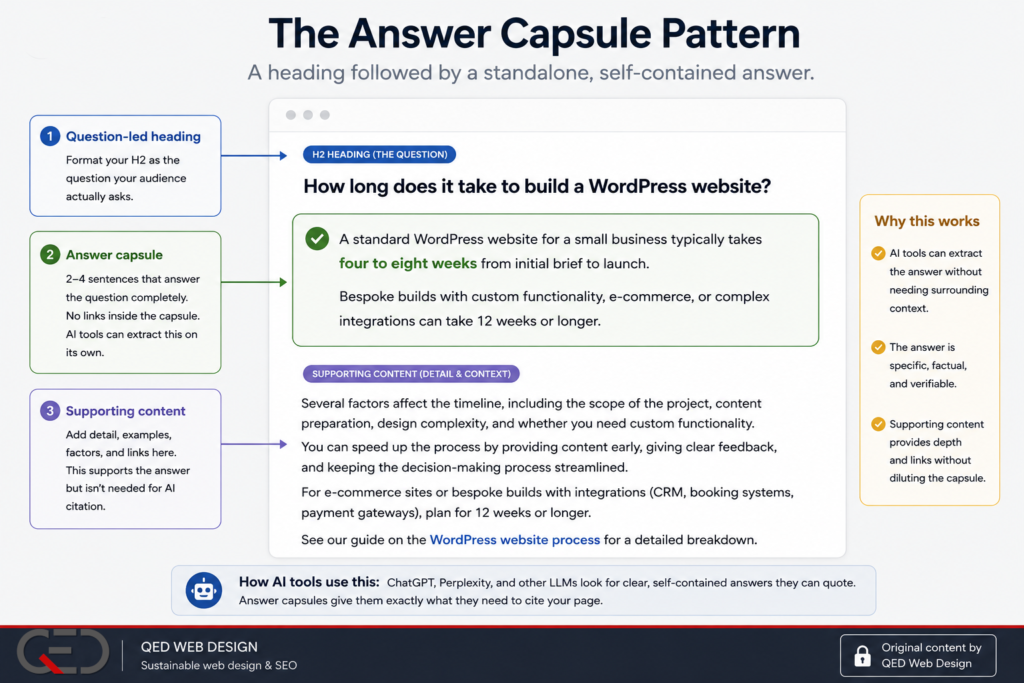
An answer capsule is a short block of text, typically two to four sentences, placed immediately after a heading that provides a complete, standalone answer to the question posed by that heading. It can be extracted by an AI system and used as a citation without needing any of the surrounding content for context.
The term comes from Search Engine Land’s research (2025), which found answer capsules were the single most consistent structural feature of blog posts receiving ChatGPT referral traffic. Just 13.2% of cited posts in their dataset lacked both an answer capsule and proprietary data.
Here is an example of an answer capsule in practice:
Heading: How long does it take to build a WordPress website?
Answer capsule: A standard WordPress website for a small business typically takes four to eight weeks from initial brief to launch. Bespoke builds with custom functionality, e-commerce, or complex integrations can take 12 weeks or longer.
That answer is complete on its own. An AI tool can quote it directly without needing the paragraphs that follow. The supporting detail (what affects timelines, how to speed up the process, pricing) goes in the body paragraphs below.
If you are writing content with the goal of being cited by ChatGPT or other AI tools, adding answer capsules to your existing H2 sections is the single highest-impact change you can make. Keep them link-free: the data suggests links inside capsules correlate with lower citation rates. For more on structuring WordPress content effectively, see our guide on how to build a WordPress website that ranks.
How do you optimise your website to be cited by AI tools?
You optimise your website for AI citations by structuring content around specific questions, writing clear standalone answers, including original data, and supporting claims with named, dated sources.
Here are the practical steps, ordered by likely impact based on the available research.
Write answer capsules for every H2 section. After each heading, include a two-to-four-sentence answer that stands alone. Do not include links inside the capsule. Based on the Search Engine Land data, this is the single most impactful structural change you can make.
Include original or proprietary data. A unique statistic from your own business, a test you ran, a client result you can verify. Even a single “owned” data point dramatically increases citation potential. For example: “QED Web Design recorded 60 ChatGPT referral sessions across 17 pages in the year to September 2026 (GA4), with the most-cited page being a technical guide on tracking GA4 ChatGPT referrals.”
Attribute claims to specific sources with dates. Instead of “studies show that…”, write “According to SE Ranking’s analysis of 129,000 domains (2025)…” AI tools prefer content they can verify, and named attribution helps them assess credibility.
Use question-led headings. Format your H2s as the questions your audience actually asks. AI tools structure their answers around questions, and content formatted the same way is easier for them to extract.
Keep paragraphs short: one idea per paragraph. Longer paragraphs with multiple ideas increase the risk of misinterpretation when an AI extracts a passage. Two to four sentences is ideal.
Update your content regularly and show the date. Include a visible “last updated” date on the page. LLMs favour content with recent timestamps over identical content with old dates.
Add Article schema markup with dateModified. Structured data helps AI systems confirm what the page is about, when it was last updated, and who authored it. Prioritise Article schema and Organisation schema. Only use FAQ schema if the content is genuinely structured as a FAQ, and only use HowTo schema if it is genuinely a step-by-step guide. Misapplied schema can hurt rather than help. See our guide on FAQ schema in Elementor and Yoast for an example of when FAQ schema is appropriate.
What you do not need. You do not need an llms.txt file. The protocol is worth understanding (see our post on what llms.txt is), but no major LLM currently requires it for citation. You also do not need to treat GEO, AEO, or “AI search optimisation” as disciplines separate from SEO. The fundamentals are the same: clear content, good structure, genuine expertise. The structural additions described above (answer capsules, attributed data, question-led headings) are refinements to good SEO practice, not a replacement for it.
Which QED pages does ChatGPT actually cite?
In the 12 months to September 2026, QED Web Design tracked 60 chatgpt.com referral sessions in GA4, spread across 17 pages. The pages ChatGPT sent visitors to were specific technical guides, not general advice articles.
Our most-cited page remains our guide on tracking ChatGPT referrals in GA4, with 9 sessions. The next most-cited were our FAQ schema in Elementor guide (6 sessions), our home page and our Online Safety Act analysis (5 each), and our post on AI search traffic from Perplexity and ChatGPT alongside our UK website design cost guide (4 each). A long tail of technical and niche posts picked up one or two sessions each.
The pattern is unmistakable and matches what we later see in Google’s own AI features: ChatGPT sends people to pages that answer a specific, factual question directly. None of the most-referred pages are general advice or thought-leadership content.
Notably, the pages ChatGPT cites are not necessarily the pages that rank well in Google. Our FAQ schema guide does not rank on page one for any competitive keyword, but ChatGPT references it when users ask about implementing FAQ schema in Elementor. The content is niche enough that ChatGPT treats it as a useful source despite its modest organic visibility.
The lesson for small business websites: you do not need to compete for high-volume keywords to earn AI citations. You need to be the clearest, most specific source on a question that people actually ask. A 1,500-word guide that answers a specific technical question will outperform a 3,000-word overview that covers a topic broadly. See our website portfolio for examples of the kind of structured content we build for clients.
How do you track AI citations to your website?
You can track ChatGPT citations to your website using your existing analytics setup. ChatGPT referral traffic appears as visits from chatgpt.com in your referral reports.
In Google Analytics 4: Create a custom channel grouping or use the referral traffic report to filter for chatgpt.com, perplexity.ai, and other AI tool domains. You can also set up UTM-based tracking if you want to segment AI referral traffic more precisely. QED Web Design published a dedicated guide on setting up GA4 ChatGPT referral tracking, which is itself one of our most-cited pages.
In server logs: If you have access to raw server logs, filter for the chatgpt.com referrer string. This is the most reliable method but requires technical access.
What you cannot track yet. There is no reliable way to know when ChatGPT mentions your brand or content without linking to you. If ChatGPT summarises information from your page but does not include a clickable citation, you will not see a referral visit. Tools claiming to track “AI mentions” are emerging, but as of September 2026, most are limited to checking specific prompts rather than monitoring all citations comprehensively. No tool currently offers complete AI citation monitoring across all platforms.
The practical approach: check your referral traffic weekly, note which pages are being cited, and look for patterns in what those pages have in common structurally. Use that information to refine your other content. For a broader look at measuring AI-driven traffic, see our analysis of AI search traffic from Perplexity and ChatGPT.
Can you influence ChatGPT citations from outside your website?
Yes. Off-site presence on platforms like Reddit, Quora, and Wikipedia significantly increases the likelihood of ChatGPT citing your brand and content, even being recommended as a Google preferred source will help.
Two things stop this being “Reddit is finished”. The drop is concentrated in ChatGPT: over the same period Reddit’s share fell only around 11% in Google AI Overviews and held roughly flat in Gemini and Perplexity, and it still holds about 4% of AI Overviews citations (Promptwatch, 2026). And there is form for recovery, with similar Reddit collapses in September 2025 and June 2026 both rebounding within weeks.
Contently’s analysis (April 2026, before the August shift covered above), drawing on the Ahrefs Brand Radar study of 75,000 brands and the SE Ranking 129,000-domain dataset, found specific multipliers for off-site presence. As of early 2026, domains with substantial brand mentions on Reddit averaged 3.9 times more ChatGPT citations than domains with minimal Reddit presence, and Quora showed a 4.1x multiplier. Reddit’s ChatGPT multiplier no longer holds after August 2026, though the Quora figure has not been retested.
Wikipedia is even more influential. Wikipedia accounts for approximately 7.8% of all ChatGPT citations and roughly 22% of ChatGPT’s training data (ConvertMate, 2025). If your brand has a Wikipedia entry, the language used there will heavily shape how ChatGPT describes you. For most small UK businesses, a Wikipedia page is not realistic (the notability threshold is high), but building the kind of independent media coverage that could eventually support one is a worthwhile long-term investment.
The most practical off-site tactic for small businesses: find the pages ChatGPT already cites when answering questions in your industry. Run your key queries through ChatGPT, note which URLs it references, and look for opportunities to be mentioned on those pages. A mention on a roundup article or comparison page that ChatGPT already pulls from is worth significantly more than a backlink from a site ChatGPT never references.
You cannot force ChatGPT to cite you. But you can make your content easier to cite (structure), more credible to cite (attribution and data), and more visible to cite (off-site presence). The combination of all three is what moves the needle. For more on whether traditional backlinks still matter alongside AI citations, see our post on whether you need backlinks to rank.
Will Google AI Overviews cite your website?
Google AI Overviews include links to source pages when the content directly supports the generated answer. You are more likely to be included if your page already ranks on page one or two for the relevant query.
Unlike ChatGPT, which draws from a broader pool of sources, Google AI Overviews are closely tied to Google’s existing organic index. The pages it cites tend to be those that already perform well in traditional search. Strong on-page structure, authoritative references, and existing organic visibility are the primary prerequisites.
For small business websites, this means AI Overviews are harder to earn than ChatGPT citations. You are unlikely to be cited in an AI Overview for a competitive query where you rank on page three or lower. Focus your AI Overview ambitions on queries where you already have page-one or page-two visibility, and treat ChatGPT and Perplexity citations as the more accessible opportunity for newer or lower-authority content.
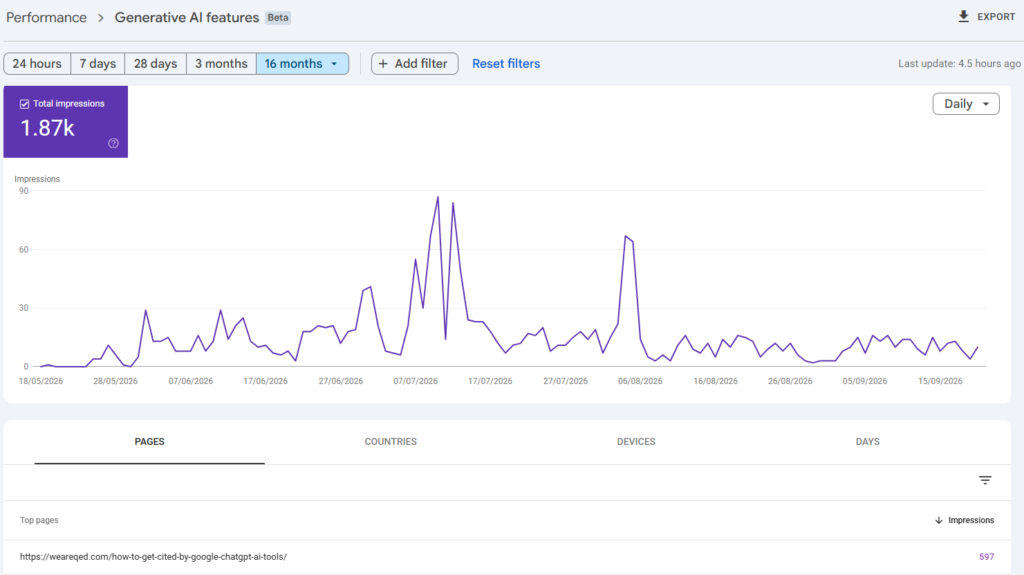
QED’s own data shows this does happen for a small site, and follows the same pattern as everything else in this guide. In Google Search Console’s Generative AI features report (Beta), which counts how often a page is shown as a source in Google’s AI Overviews and AI Mode, weareqed.com recorded around 1,870 such impressions across 48 pages in the 16 months to September 2026. These are impressions, not clicks: they measure how often Google’s AI surfaced our content, not how many people clicked through.
The most-surfaced page was this very article, with 597 impressions, followed by a Windows troubleshooting post (558) and a WordPress error fix (126). Specific, structured, technical answers get surfaced far more than general marketing pages, exactly as they do in ChatGPT. The difference is scale and metric: Google’s AI features showed our pages often, while ChatGPT sent a smaller number of actual clicks, 60 referral sessions in the year to September 2026.
One important caveat: AI Overviews can suppress organic click-through rates for the queries they appear on. If you notice high impressions but very low CTR for a query in Google Search Console’s main Performance report, check whether an AI Overview is answering that query directly. Low CTR in that scenario is not a problem with your title tag or meta description. It means Google is answering the question before users reach the organic results.
This is also why Google’s preferred sources feature is not something you can optimise for; it depends on readers already knowing your name, whereas the structural work here is what actually earns it.
Is AEO or GEO different from SEO?
No. Answer Engine Optimisation (AEO) and Generative Engine Optimisation (GEO) are not separate disciplines. They are search engine optimisation applied to more surfaces, and Google says so in its own words. In its May 2026 guidance on generative AI features, Google states that because AI Overviews and AI Mode are built on core Search, optimising for generative AI is still SEO (Google Search Central, 2026).
The clearest way to hold this in your head is that SEO has not been replaced, it has been rebranded. Search Engine Optimisation has quietly become Search Everywhere Optimisation. The number of places you need to show up has multiplied, Google, ChatGPT, Perplexity, Gemini, Maps, YouTube, but the craft underneath is the same one small business SEO has always relied on. Answer-first structure, clear entities, question-led content and citation-worthy sources were all SEO long before anyone reached for a new acronym.
The common claim is that AEO and GEO add a new layer of work: answer extraction, entity clarity, citation-worthiness, testing how content surfaces in AI answers. The counter-evidence is that every one of those was already SEO. Featured snippets have rewarded answer-first structure for a decade, and structured data and E-E-A-T are long-standing ranking concerns. None of it is a new craft, it is the same craft aimed at more destinations.
Two things have genuinely changed, and it is worth being honest about them. The centre of gravity has shifted, so structure, extractability and off-site authority now carry more weight than when ten blue links were the whole game. And measurement is new: you cannot see a ChatGPT or Perplexity citation in Google Search Console, so confirming you were cited needs different tooling. But the work that earns the citation is SEO. A new dashboard to prove it worked is not a new discipline.
So when someone sells you AEO, GEO, AIO or SXO as separate services, the fair question is the one that ends most of these conversations: what would you do for AI search that you would not already do for good SEO content? The honest answer is “refine the emphasis and measure it differently”, not “a different craft”. At QED, a sustainable web design and SEO studio in South Devon, we treat it as one discipline with more surfaces, which is also the least confusing thing to tell a small business owner spending limited money.
What should you avoid when trying to get cited by AI?
Avoid publishing vague, unattributed content and expecting AI tools to cite it. LLMs prioritise specificity and verifiability, and they are increasingly effective at recognising thin content.
Specific things to avoid: overlong paragraphs that combine multiple ideas (these are hard for AI to extract cleanly), marketing copy with no factual substance, unsupported claims without named sources, AI-generated content that has not been reviewed for accuracy, and outdated statistics or broken citations.
Publishing high volumes of generic content does not increase your chances of being cited. A site with 500 thin articles is less likely to earn AI citations than a site with 50 detailed, well-structured guides. ChatGPT and other LLMs do not reward volume. They reward clarity, specificity, and verifiable expertise.
Conclusion
Getting cited by ChatGPT and other AI tools comes down to three things: specific SEO content that answers real questions, clear structure that AI can extract from (answer capsules, question-led headings, short paragraphs), and verifiable data or expertise that gives the AI confidence in your source.
You do not need a massive site or high domain authority. QED Web Design has earned 60 chatgpt.com referral sessions from a small agency website by publishing specific, factual guides on niche topics. The pages that get cited are the ones that answer a question better than anyone else, not the ones that try to cover everything.
Sources
- Search Engine Land, “How to get cited by ChatGPT: The content traits LLMs quote most“, 2025
- Contently, “How to Get Your Brand Cited in ChatGPT (Verified Tactics for 2026)”, 2026
- SE Ranking, “129K-domain analysis of ChatGPT citation patterns“, 2025
- Similarweb, “ChatGPT usage statistics”, 2026
- ConvertMate, “Wikipedia’s role in ChatGPT training data”, 2025
- Google Search Central, “AI Overviews and how they work“, 2025
- Google Search Central, “Optimizing your website for generative AI features on Google Search“, 2026
- Promptwatch, “Reddit citations are dropping in ChatGPT“, 2026
- OtterlyAI, “ChatGPT cut Reddit citations by at least 73% in August 2026“, 2026
- Search Engine Land, “Reddit’s ChatGPT Search citations fell 86% in four days“, 2026