Google Preferred Sources: Do They Help Small Websites?

sustainable website scroll down

TL;DR: Google preferred sources is a setting that lets a reader nominate websites they already trust, so those sites appear more often in Top Stories, AI Overviews and AI Mode. It rewards loyalty. It does not create discovery.

Google’s Head of Search has argued the feature helps small publishers get found. She offered no data. The only independent behavioural study of AI search, from Pew Research Center, found organic clicks nearly halve when an AI summary appears.

If a UK reader has never heard of your business, they will never nominate you. Below we explain what the feature does, who it genuinely helps, what the numbers actually show, and what a small business should do instead.


Google preferred sources is the Search setting that lets a signed-in user nominate the websites they want to see more of, and as of July 2026 those nominations now carry through into AI Overviews and AI Mode.

At QED web design have spent the last month reading the coverage of this feature and testing the claims made about it, because several of our clients asked whether they needed to worry about it.

The short answer is no, and the reason is structural rather than technical. A feature that lets people pick the sites they already read cannot, by definition, introduce them to a site they have never read.

Nominating a preferred source requires knowing the source exists first. If you run a plumbing firm in Newton Abbot or a recruitment agency in Liverpool, nobody is going to type your name into a picker.

That does not make the feature irrelevant. It makes it a retention tool that has been described as a discovery tool, and the difference matters when you are deciding where to spend a limited SEO budget. Here is what it actually does.

Key Takeaways

Preferred sources is a personalisation setting, not a ranking factor. No amount of on-page work makes Google add you to somebody’s list.

  • Preferred sources requires a reader to already know your brand and choose it deliberately, which means it amplifies existing trust rather than creating new visibility.
  • Pew Research Center tracked 68,879 real Google searches across 900 US adults in March 2025 and found users clicked an organic result in 8% of searches showing an AI summary, against 15% of searches without one.
  • Links inside an AI Overview itself were clicked in roughly 1% of visits in the same Pew dataset.
  • Google has published no data showing that personalisation or preferred-source status improves visibility for small publishers, and Search Console does not break out the figures that would let you check.
  • Being nominated as a preferred source is a downstream effect of brand recognition, so the work that earns it is the same work that earns rankings and citations.
 

What are Google preferred sources?

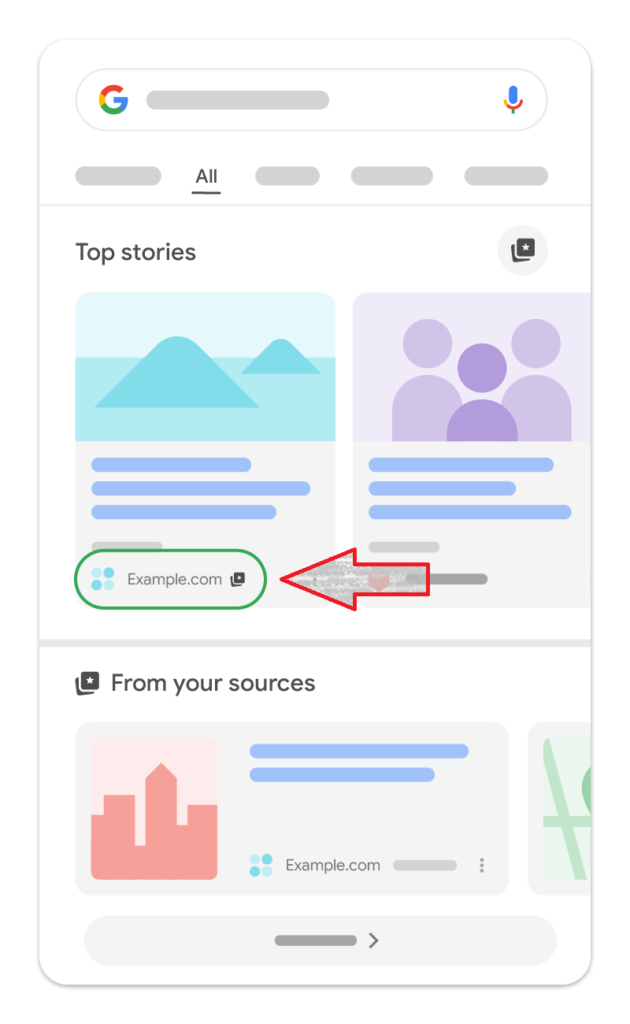
Google preferred sources is a Search setting that lets a signed-in user nominate specific websites, after which Google shows more results from those sites in Top Stories and, since 27 May 2026, surfaces them with a visible badge inside AI Overviews and AI Mode. AI Overviews are the AI-generated summary blocks that sit above the ordinary blue links, and AI Mode is the conversational search experience that replaced them for longer queries.

The mechanic is deliberately simple. A reader taps an icon, searches for a publication, and ticks it. From then on, when that publication has covered a topic the reader is searching for, it is more likely to appear, and it carries a label saying the reader chose it.
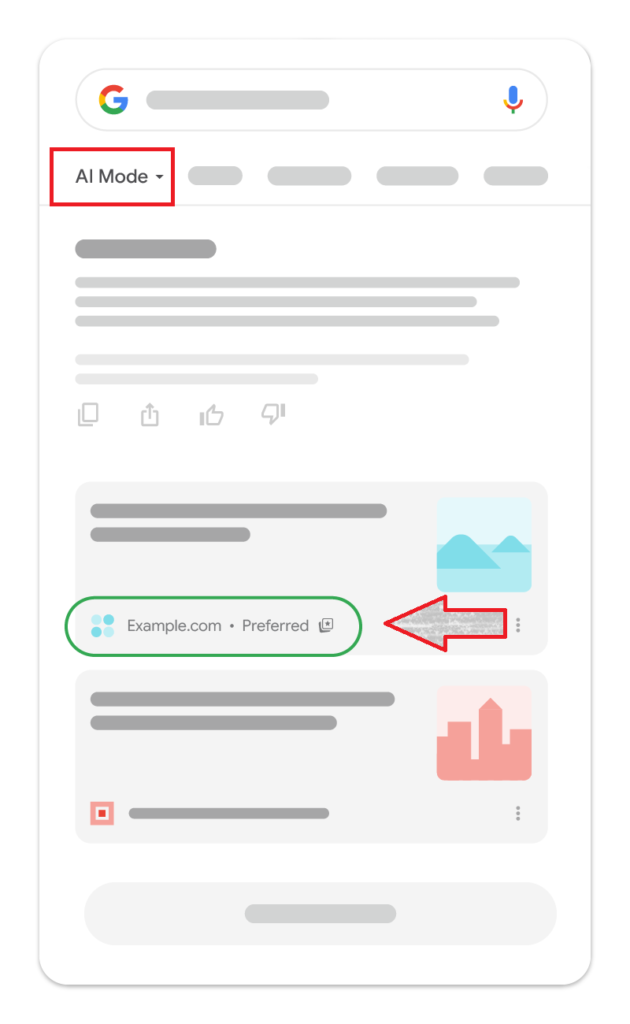
Google preferred sources in AI mode
Google preferred sources in Search mode


Google reports that the feature now covers more than 345,000 unique nominated sources, and that people click a link carrying the Preferred label roughly twice as often as they click an unlabelled one, according to figures Google supplied and PPC Land reported in July 2026. Treat both numbers as vendor-supplied. Google has published no baseline, no sample size, and no methodology for either.

Common mistake: Preferred sources is not something you optimise for. There is no schema, no meta tag, and no submission form. Any agency selling you “preferred source optimisation” is selling you a setting inside somebody else’s browser.

The important detail is who does the choosing. In section four we look at what happens when nobody chooses you.


Did Google say preferred sources help small publishers?

Liz Reid, VP and Head of Google Search, speaking on episode 135 of the AI Inside podcast on 26 June 2026, argued that personalisation and preferred sources help small publishers surface in AI search rather than burying them. She provided no data to support the claim.

Her argument runs as follows. Unpersonalised keyword search makes every result look the same, so the content that wins is whatever wins at scale, which is usually a handful of large outlets. Personalisation, she suggested, pushes results into the tail and surfaces the specialist reviewer, the niche merchant and the local journalist. Pressed by co-host Jeff Jarvis on Eli Pariser’s filter bubble thesis, she inverted it: not personalising creates more filter bubbles, because a reader who cannot find their favourite source through Search simply goes straight to it and never sees anything else.

Taken as an argument about product design, that is coherent. Taken as a claim about small publisher visibility, it is unverified. Google has not shipped any measurement that would let a publisher test it. Search Console broke out AI impressions but did not include click data for them, a gap Reid acknowledged on the same podcast when she said AI Mode is one year old and AI Overviews two, and that Google is still learning.

An executive’s argument is a hypothesis. A hypothesis with no published data and no way for you to test it is not a reason to change your content strategy.

We have written before about the same pattern in how the SEO industry reacts to Google statements, where a John Mueller comment about FAQ rich results was inflated into “FAQ schema is bad” across half the industry. The original statement was narrower than the reaction to it. So it is here.


Do Google preferred sources help a small business get found?

Google preferred sources helps businesses whose readers already know their name, and does nothing at all for businesses whose readers do not. The mechanism is a preference filter applied to a known set, so it cannot introduce an unknown site into that set.

Consider what has to happen before the feature does anything for you. A person opens Google, taps the preferred sources icon, types your business name, finds you, and ticks the box. Every one of those steps depends on brand recognition that already exists. The feature then rewards it. Nothing in the chain generates it.


Your situation What preferred sources does Net effect
National news brand with a daily readership Returning readers nominate you, so your coverage appears with a badge in Top Stories and AI Mode Real benefit
Established local paper or specialist trade title A committed minority nominate you, and the badge lifts click-through among people already looking for you Marginal benefit
Small business with a blog and a modest audience A handful of existing customers might nominate you, if they know the setting exists Negligible
New site nobody has heard of Nothing. Nomination requires prior awareness, which is the exact thing you do not have No effect
QED Web Design, weareqed.com · UK small business perspective, 2026

There is a genuine exception. If you publish something no one else has, and readers seek you out for it specifically, preferred sources gives those readers a way to make that preference legible to Google. Jeff Jarvis pushed exactly this point on the podcast, suggesting small publishers behave as data repositories rather than article factories: transcribe the parish council meeting, catalogue the menus, become the canonical source for a defined patch of ground. Reid did not disagree.

For most UK small businesses, though, that description does not fit. You are not the canonical source for anything yet, and the honest sequence is visibility first, nomination second.


What does the independent data say?

Pew Research Center analysed the real browsing behaviour of 900 US adults across 68,879 Google searches in March 2025 and found that users clicked an organic result in 8% of searches where an AI summary appeared, compared with 15% where it did not. Links inside the AI summary itself were clicked in around 1% of visits.

Sessions also ended more often. Pew recorded browsing sessions terminating after 26% of pages carrying an AI summary, against 16% of pages without one. Google disputed the methodology and did not publish counter-data.

On personalisation specifically, almost nothing independent exists. The one attempt we could find is an iPullRank experiment on Google’s Personal Intelligence feature, which found personal signals increased how often seeded brands appeared in AI Mode and concluded that personalisation adds to web grounding rather than replacing it. The scope was three accounts, over seventeen days, all opted in. Interesting, but nowhere near enough to base a strategy on. Nothing tests the preferred-sources claim at all.

Pro tip: When a source describes a figure as “our own data” or you cannot find a methodology page, write the word “vendor” next to it in your notes. It stops the number quietly becoming a fact three articles downstream.

Put the two together and the picture for a small business is clear enough. AI search reduces clicks on average, and the one feature offered as a remedy has no evidence attached and works only for sites with an existing audience. Section six covers the part you can control. It is not exciting, which is rather the point.


What should a small business do instead?

Build the thing preferred sources depends on, which is a reason for somebody to want more of your content. Brand recognition, distinctive information and clear structure are what earn rankings, citations and, eventually, nominations. The order never reverses.

The common misconception here is that AI search is a new discipline requiring new tactics. It is not. When we ran a six-month content campaign for The SV Group, a Liverpool hospitality recruiter, the work that produced their rankings and featured snippet results was ordinary: fix the heading hierarchy, rewrite the pages around real queries, build internal links that show topical architecture, then publish content that answered questions nobody else was answering. No feature toggle was involved. The same structural work is what gets pages cited by ChatGPT and AI Overviews.

Practically, for a UK small business in 2026:

  • Publish at least one thing per quarter that contains information available nowhere else. Your own pricing, your own test results, your own failure rates.
  • Put a complete, standalone answer in the first two sentences under every H2 heading.
  • Name your sources inline with publisher and year, and label vendor figures as vendor figures.
  • Track branded search volume in Search Console. Growth there is the leading indicator that anybody would ever nominate you.
  • Ignore anyone selling optimisation for a browser setting.

The limitation on all of the above is time. Brand recognition compounds slowly, and a business needing enquiries within six weeks should be spending on advertising, not on content. We say that to prospective clients regularly, and it costs us work.

More of our thinking on how search claims survive contact with evidence sits in our opinion and insights archive.


The takeaway

Google preferred sources is a loyalty feature that has been publicly described as a discovery feature, and the distinction decides whether it is worth a minute of your attention. If readers already choose you, it helps them choose you more efficiently. If they do not know you exist, it does nothing, and no published evidence suggests otherwise.

Reid may well turn out to be right that personalisation opens up the tail of the web. Until Google ships the measurement that would show it, the claim sits alongside every other unfalsifiable assertion a platform has made about its own product. Test it against your own analytics, not against a podcast.

Sources

If you would like a straight assessment of where your site actually stands in search, without the hype, get in touch with QED web design. 

Google preferred sources

To see the effect of our
content creation,
See our case study
on The SV Group

We created content over a six month period targeting key areas where their business wanted to expand