TL;DR: Web design for small businesses is the single biggest factor in whether a UK company gets found online, gets trusted, and gets contacted. A site that loads fast, works on mobile, and answers the right questions will outperform a visually impressive one every time.
Of the 5.7 million private sector businesses in the UK at the start of 2025, 5.64 million were small, according to the Department for Business and Trade. Most compete for attention with limited budgets and no marketing team, so the website has to do the heavy lifting.
This guide covers what a small business website should include, what it realistically costs, the common mistakes, and how to pick a web designer who delivers commercial results.
Key takeaways
A small business website in the UK typically costs between £500 and £6,000, and most projects land between £1,500 and £6,000, depending on who builds it and what the price covers.
Most small business sites need only 5 to 15 pages to work effectively, but every page must have a clear purpose and a path toward an enquiry or action.
Speed matters more than aesthetics: Akamai’s 2017 retail performance research found a 100-millisecond delay in load time could cut conversion rates by 7%.
16.1 million people in the UK, 24% of the population, reported a disability in the government’s Family Resources Survey for 2022 to 2023, so an inaccessible site turns away a large share of potential customers.
QED Web Design has rebuilt UK hospitality and recruitment sites where simplifying the layout alone cut page weight by more than 60%, and search impressions rose without any new content.
Web design for small business is one of those phrases that gets thrown around without much substance behind it. At QED Web Design, we work almost exclusively with small businesses across the UK. Hospitality venues, recruitment firms, professional services, tradespeople. The pattern is consistent: most small business owners know they need a better website, but they do not know what “better” actually means in practice.
Everything here is built from that experience. Not theory, not trends, but the practical decisions that separate a website that generates enquiries from one that quietly gathers dust. If you are looking for a web design partner who understands small business constraints, this is what we think you should know first.
Does your small business actually need a website?
Yes. In almost every case, a UK small business needs a website, even if it already has a social media presence or relies on word of mouth.
A website is not just a digital brochure. It is the one piece of online real estate you fully control. Social media platforms change their algorithms, limit your reach, and can suspend your account without warning. Your website sits outside all of that. It is where Google indexes your business, where customers check your legitimacy, and where enquiries actually happen.
Think of social media as a market stall you rent by the day and your website as the shop you own. The stall is useful for footfall. The shop is where you decide the opening hours, the layout and what happens to the till.
The exception is genuinely pre-revenue businesses still validating an idea. A landing page or even a well-maintained Google Business Profile might be enough at that stage. But the moment you are actively trading, a website stops being optional and starts being infrastructure. The quick quiz below helps you work out which camp you are in.
What is web design for small business?
Web design for small business is the process of building a website that prioritises clarity, speed, trust, and lead generation over visual complexity.
The distinction matters because small business web design operates under different constraints than enterprise or agency work. Budgets are tighter. Page counts are lower. There is no dedicated content team producing fresh material every week. The design has to work harder per page, communicating credibility immediately and guiding visitors toward a specific action, whether that is a phone call, a form submission, or a booking.
At QED Web Design, most of the small business sites we build are between 5 and 15 pages. That is not a limitation. It is an advantage. Fewer pages means every page has to earn its place, which forces the kind of focus that actually converts visitors into customers.
A common misconception is that web design means making things look attractive. In practice, effective small business web design is measurable. Page speed, bounce rate, enquiry completion rate, and organic search impressions all change when design decisions improve. The aesthetics matter, but they are a secondary outcome of getting the structure, content hierarchy, and technical foundations right.
What should a small business website include?
A small business website should include, at minimum, five core pages: a homepage, an about page, a services or products page, a contact page, and a blog or news section.
Each page has a specific job. The homepage establishes what you do, who you do it for, and why someone should care, all within the first few seconds of loading. The about page builds trust by showing the people behind the business. The services page details what you offer with enough specificity that a potential customer can self-qualify. The contact page removes friction from the enquiry process. The blog gives Google a reason to keep crawling your site and provides answers to the questions your customers are actually searching for.
Beyond those five, you might add case studies, testimonials, a portfolio, an FAQ page, or location-specific landing pages depending on your business model. QED Web Design typically recommends case studies for service businesses because they demonstrate results rather than just claiming them. You can see this approach in our portfolio and case studies.
Every page should include a clear call to action. Not three competing buttons, not a vague “learn more” link, but one obvious next step. If a visitor reads your services page and cannot immediately see how to get in touch, the page is not doing its job.
Technical essentials that should be built into every small business website include an SSL certificate (the padlock in the browser bar), mobile-responsive design, fast loading times under three seconds, basic schema markup (Organisation schema at minimum), and an XML sitemap submitted to Google Search Console. These are not premium extras. They are baseline requirements in 2026.
Why does web design matter more for small businesses?
Web design matters more for small businesses because the website often replaces a shopfront, a sales team, and a brochure combined.
For UK service businesses, the website is frequently the first and only interaction a potential customer has before picking up the phone or sending an enquiry. There is no brand recognition to fall back on. No national advertising campaign creating awareness. The website is doing all of that work on its own.
The commercial impact is direct. A well-structured small business website that loads quickly, presents information clearly, and makes it easy to get in touch will generate more enquiries than a visually impressive site that confuses visitors or buries the contact details. QED Web Design has rebuilt several UK hospitality and recruitment sites where simplifying the layout alone reduced page weight by over 60%. In those cases, search impressions increased without adding any new content.
Small businesses also face a credibility asymmetry that larger companies do not. A customer searching for a plumber, a solicitor, or a restaurant does not know your reputation yet. Your website is the evidence they use to decide whether you are worth contacting. Design quality is, for that moment, a proxy for service quality.
What are the most common small business website mistakes?
Most small business website problems are design decisions disguised as content or marketing issues.
Trying to say everything at once
Overloaded homepages with multiple calls to action, dense text blocks, and competing messages create friction rather than clarity. Your homepage is not a brochure. It is a signpost. Point people in the right direction and let the inner pages do the detailed work.
Using a template without adapting it
Off-the-shelf WordPress themes and page builder templates are not inherently bad, but when left unedited they load unnecessary scripts, sliders, animations, and layout elements that slow the site and confuse both users and search engines. A theme is a starting point, not a finished product.
Ignoring mobile
Google uses mobile-first indexing, so your site is evaluated on its mobile version, regardless of how good it looks on a desktop monitor (Google Search Central). In the UK, smartphones accounted for 75% of men’s and 79% of women’s time online in May 2025, according to Ofcom’s Online Nation report. If your site is awkward to use on a phone, it will underperform in search results and in enquiries.
Building the site and forgetting about it
A website is not a one-off project. It needs regular updates, security patches, content refreshes, and performance monitoring. WordPress sites that go unmaintained for 12 months or more frequently develop plugin conflicts, security vulnerabilities, and outdated content that damages both rankings and trust.
DIY when the stakes are high
Website builders like Wix and Squarespace have a place, particularly for very early-stage businesses testing an idea. But for an established business that depends on its website for enquiries, leads, or bookings, a professionally built site on WordPress provides more control, better SEO foundations, and long-term flexibility.
The trade-off is cost upfront versus cost over time. Here is what you actually get at each level.
What you get
Website builder (Wix, Squarespace)
Freelancer
Small agency
Typical cost
Around £9 to £12 a month on annual billing, plus your time
£500 to £3,000
£3,000 to £8,000 (QED: £500 entry package, bespoke from £1,800)
Who does the work
You
One person
A defined process: discovery, design, build, testing
Design quality
Template-bound
Varies hugely
Built to your brand
SEO foundations
Basic, with limited control over headings and schema
Often missed or surface-level
Built in: URLs, headings, metadata, image sizing
Ownership
You rent the platform
Check the contract
Yours, portable to any host
Support after launch
Help docs
Often none after handover
Care plans, updates and monitoring
Best for
Testing an idea before spending real money
Tight budgets where you know the person's work
Businesses that rely on enquiries, bookings or sales
Web design supports SEO by controlling how search engines crawl, render, and evaluate your site. Good design and good SEO are not separate disciplines. They are the same discipline applied at different levels.
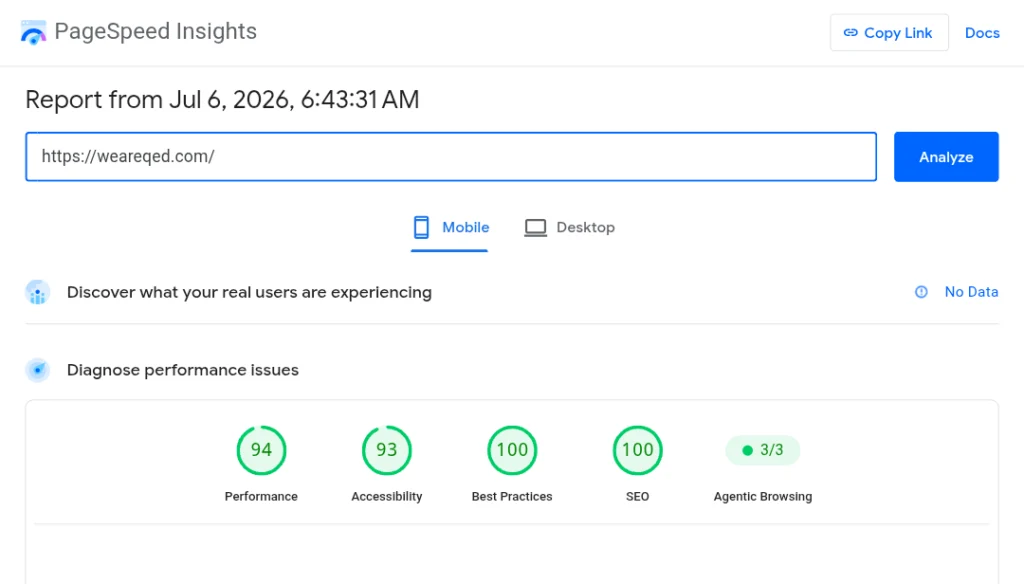
A fast website, mobile first speed is important for SEO
On-page structure
Clean heading structure (H1, H2, H3 used in correct hierarchy) helps Google understand what each page is about. Fast-loading pages improve Core Web Vitals, the set of performance metrics Google uses to assess user experience. Accessible colour contrast and readable typography improve the experience Google is trying to measure.
Technical build
Largest Contentful Paint (LCP), the Core Web Vital that measures how quickly the main visible content loads, should be under 2.5 seconds for a good score. Cumulative Layout Shift (CLS), which measures visual stability as the page loads, should be under 0.1. These are not abstract technical targets. They reflect what users experience, and Google measures them from real Chrome browser data.
SEO is not an afterthought
A persistent myth is that SEO can be bolted on after the site is built. In reality, design choices like heading structure, internal linking, URL patterns, and page templates either support or undermine SEO from the very start. Retrofitting SEO onto a poorly structured site costs significantly more than building it in from day one. For a deeper look, see how web design affects SEO.
Accessibility and SEO share the same foundations
Descriptive alt text on images helps visually impaired users and gives Google additional context for image search. Semantic HTML, meaning proper heading tags, landmark roles and structured content, helps screen readers and search engine crawlers alike. With 16.1 million people in the UK reporting a disability (Family Resources Survey, DWP, 2022 to 2023), ignoring accessibility means ignoring a substantial share of your market.
How much should small business web design cost?
Small business web design in the UK typically costs between £500 and £6,000, and most projects land between £1,500 and £6,000. Where you fall depends less on page count than on who does the work and how much of the surrounding job the price covers.
At the lower end, you are looking at a small brochure site on a customised template. QED Web Design’s own £500 website package sits here, with multi-page bespoke builds starting at £1,800. At the higher end, expect bespoke design, content strategy, performance optimisation, and ongoing support.
Cost alone is not the deciding factor. The real question is whether the design helps the business generate enquiries, bookings, or sales. A £1,500 site that converts consistently will outperform a £6,000 site that looks impressive but does not guide visitors toward taking action.
Common mistake: Treating a low price as a red flag on its own. A cheap quote is not the problem; an unexplained one is. Some providers offer real value at low prices by keeping the product deliberately narrow. Ask what is included, what is excluded, and who owns the site. Be just as cautious of an agency quoting £10,000 or more for a 10-page brochure site without a clear reason for the extra cost.
For a full breakdown by project type, including running costs after launch, see the detailed guide to website design cost in the UK.
How long does a small business website take to build?
A typical small business website takes between 4 and 8 weeks from initial brief to launch, though the timeline depends more on client responsiveness than on the build itself. A small brochure site with content ready to go can be much quicker: our £500 package is usually completed within 7 to 14 days of design approval.
The design and development work for a 5 to 10 page site usually takes 2 to 3 weeks of active work. The rest of the timeline is typically spent waiting for content, images, feedback on drafts, and sign-off. In QED Web Design’s experience, the single biggest cause of project delays is content: waiting for the written copy, photography, and brand assets needed to populate the site.
A practical way to speed things up is to have your content ready before the design phase starts. That means page copy, a logo in vector format, team photos if relevant, and a clear idea of what your calls to action should be.
Rush jobs are possible but rarely advisable. Compressing a 6-week project into 10 days usually means cutting corners on testing, SEO setup, or content quality, all of which cost more to fix later than to get right the first time.
How do you choose a web designer for a small business?
The best web designer for a small business understands commercial outcomes, not just visual trends.
Ask potential designers how they measure success. If the answer focuses only on aesthetics or “brand feel”, that is a warning sign. Designers who understand small business web design talk about speed, conversions, accessibility, search visibility, and ongoing maintenance. Here are specific questions worth asking before you commit.
“Can I see sites you have built that actually rank on Google?”
Anyone can build an attractive site. Far fewer can build one that appears in search results for relevant terms. Ask for examples and check them yourself.
“Do I own the website, the domain, and the hosting?”
Some agencies use proprietary platforms or retain ownership of the domain. You should own everything from day one, with full access to transfer it if you ever want to move.
“What happens after launch?”
A responsible designer will offer a care plan or at least outline what ongoing maintenance looks like. WordPress sites need regular updates, backups, and security monitoring. If the designer’s answer is “we hand it over and you are on your own”, factor in the cost of finding someone else to maintain it. At QED Web Design we include a minimum of 6 months of support and maintenance with all our website builds.
“What would you remove from my current site?”
Designers who cannot prioritise are unlikely to deliver clarity. The best small business sites are defined as much by what they leave out as by what they include.
When local visibility matters to your business, understanding how local SEO differs from broader SEO should be part of the conversation with any designer you are considering.
When does this advice not apply?
The guidance above may not apply to businesses that rely entirely on third-party platforms such as Amazon, Etsy, or social media for sales.
If your primary sales channel is a marketplace, a website may function more as a credibility check than a conversion tool. In those cases, a simpler, lower-cost site may be sufficient: something that confirms you are a legitimate business and provides contact details, without the full commercial optimisation described above.
Similarly, very early-stage businesses still testing a product or service idea may not need a fully optimised build yet. A one-page landing site or a well-maintained Google Business Profile might be enough while you validate demand. The key is recognising when your website becomes a growth constraint rather than an optional extra, and acting before it costs you customers.
Businesses that win all their work through personal referrals may also find a basic web presence is enough. But even then, a professional-looking site helps when customers search your business name to check you are legitimate before handing over a deposit.
What should you do next?
Web design for small business is not about keeping up with trends. It is about removing friction between what a customer wants and what your business offers.
In the UK market, clear, fast, accessible websites consistently outperform visually complex ones. Design decisions compound over time, affecting SEO, trust, and conversion rates together. The businesses that treat their website as working infrastructure rather than a one-off project are the ones that see sustained results.
If your current site feels like it is holding the business back, the next step is usually simplification, not expansion. Strip out what is not working, fix the technical foundations, and make sure every page has a clear purpose and a path to action.
To provide the best experiences, we use technologies like cookies to store and/or access device information. Consenting to these technologies will allow us to process data such as browsing behavior or unique IDs on this site. Not consenting or withdrawing consent, may adversely affect certain features and functions.
Functional
Always active
The technical storage or access is strictly necessary for the legitimate purpose of enabling the use of a specific service explicitly requested by the subscriber or user, or for the sole purpose of carrying out the transmission of a communication over an electronic communications network.
Preferences
The technical storage or access is necessary for the legitimate purpose of storing preferences that are not requested by the subscriber or user.
Statistics
The technical storage or access that is used exclusively for statistical purposes.The technical storage or access that is used exclusively for anonymous statistical purposes. Without a subpoena, voluntary compliance on the part of your Internet Service Provider, or additional records from a third party, information stored or retrieved for this purpose alone cannot usually be used to identify you.
Marketing
The technical storage or access is required to create user profiles to send advertising, or to track the user on a website or across several websites for similar marketing purposes.