TL;DR: Good website design for restaurants is about filling tables, not winning design awards. It needs to load fast, work on a phone, show an up-to-date menu, take bookings, and be found on Google.
QED Web Design builds sustainable restaurant and hospitality websites, and our team brings 27 years of hospitality experience to the table, so we know what actually matters to a busy operator.
This guide covers what a restaurant website needs, what it costs, how to get found locally, and why a fast, low-carbon site is a commercial advantage, not just a green badge.
- A restaurant website should do a job: show the menu, take bookings, work on mobile, and bring people through the door.
- Most diners find you on a phone, so a slow or fiddly mobile site loses covers before anyone reads the menu.
- Being found on Google for local searches like “restaurant near me” comes down to local SEO, which cheap builds skip.
- Our 2026 study found the average Michelin Green Star restaurant homepage still emits around 1.92g of CO2 per visit, far more than it needs to.
- QED brings 27 years of hospitality experience, so we build restaurant websites that understand the trade, not just the code.
There is a particular kind of restaurant website that looks stunning and does nothing. Big autoplay video, a clever animated intro, gorgeous photography, and somewhere buried under all of it, a menu from two summers ago and no obvious way to book a table. Good website design for restaurants is the opposite of that. It is a working tool that fills covers, and everything else is secondary.
At QED web design, we build sustainable hospitality websites, and because our owner spent 27 years in the trade, including time in Michelin-starred kitchens, we tend to start from what a service actually needs rather than what looks good in a portfolio.
What does a restaurant website actually need?
A restaurant website needs five things above all else: a fast load, a mobile-first design, a current menu, an easy way to book, and clear practical details like location, opening hours, and parking. Get those right and you are ahead of most of your competition. Everything else is a nice-to-have.
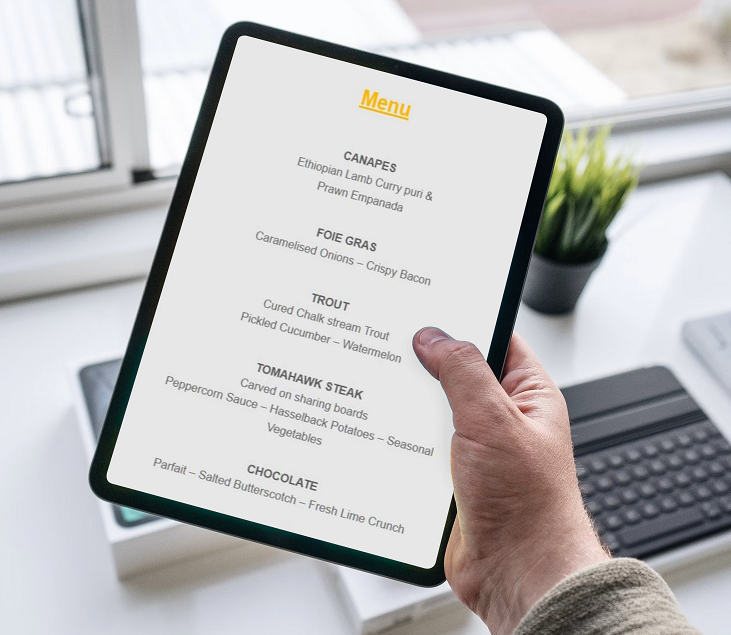
The menu is the page people came for, so it should be genuinely easy to find and read, and it must be current. A PDF that downloads slowly and pinches awkwardly on a phone is a quiet way to lose a booking. Plain, readable text that loads instantly beats a beautiful PDF every time.
Practical details matter more than owners expect. Where are you, when are you open, can I park, do you cater for dietaries. A diner deciding between you and somewhere else will often pick whoever answers those questions fastest.
The booking question deserves its own answer, because it is where a lot of restaurant sites either shine or fall down.
Do you need online booking on your restaurant website?
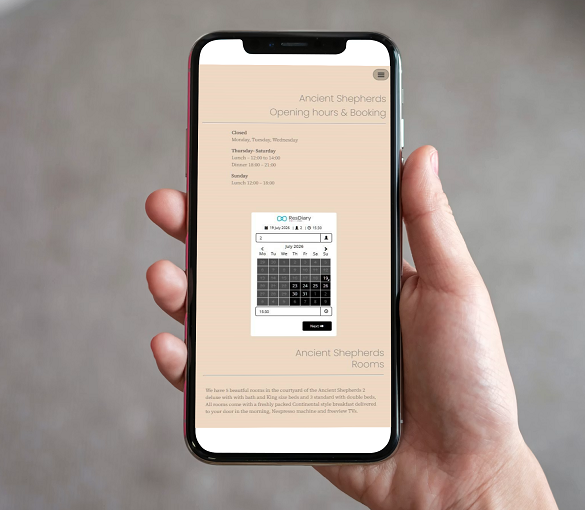
Most restaurants benefit from online booking, because a large share of reservations now happen outside opening hours when nobody is there to answer the phone. If someone decides at nine in the evening that they fancy a table on Friday, a booking button captures that. A phone number alone does not.
That said, it is not one-size-fits-all. A small bistro doing forty covers might run perfectly well on a simple booking form or a phone-and-email setup, while a busier operation will want a proper reservations system that manages tables and reduces no-shows. The right answer depends on your size and how you like to run service.
Whatever you choose, none of it earns its keep if diners cannot find you in the first place, which brings us to Google.
How do you get a restaurant found on Google?
You get a restaurant found on Google mainly through local SEO, which is the work of making your site and listings show up for location-based searches like “restaurant near me” or “best Sunday roast” plus your town. For hospitality, this is arguably the single highest-value thing you can get right, because diners search locally and they search on the move.
The foundation is your Google Business Profile, the free listing that puts you on the map, shows your hours and photos, and carries your reviews. Keeping it accurate and active does a lot of heavy lifting. On the site itself, clear location signals, a readable menu Google can actually crawl, fast loading, and pages that answer real diner questions all feed into how you rank. We explain the mechanics in our guide to what local SEO is and how it works in the UK.
There is an honest limit worth stating. In a competitive dining town, local SEO is a steady climb, not an overnight jump. It rewards consistency. How the site is actually built feeds straight into this, which is where speed and sustainability come in.
Why does a fast, low-carbon site matter for restaurants?
A fast, low-carbon restaurant website matters because speed and sustainability are the same thing viewed from two angles, and both directly affect whether a hungry visitor sticks around or bounces to a competitor. Restaurant sites are unusually prone to bloat, because the default brief is “make it feel premium”, which usually means huge images and autoplay video.
We see this clearly in our own research. In our 2026 study of Michelin Green Star restaurant websites, the average homepage emitted around 1.92g of CO2 per visit, with the biggest culprits being oversized photography, unnecessary scripts, and video-first design. These are restaurants leading the world on sustainable sourcing and waste, yet their websites often tell a different story. You can read the full findings in our 2026 Michelin Green Star website study.
The point for an operator is not the green badge, it is that the lean site is the one that loads before an impatient diner gives up. You can see how this plays out across our portfolio of hospitality and restaurant sites. That leaves the question every owner really wants answered: what does it cost.
What does website design for restaurants cost?
Website design for restaurants typically starts around £500 for a straightforward site and rises with features like online booking, multiple locations, or an events and functions section. At QED Web Design, a restaurant website starts from £500 with SEO built in as standard, rather than sold to you later as an expensive extra.
The variation is driven by real things, not guesswork. A single-site bistro that needs a menu, booking, and good local visibility is a different job from a small group with several venues, private dining, and an events calendar. Copywriting, professional photography, and ongoing support all move the figure too.
Be cautious at the very bottom of the market. The free or near-free restaurant website offers usually come with a catch, whether that is your content locked to a platform you do not own, a permanent monthly fee, or a template shared with a hundred other venues.
The honest bottom line is that a restaurant website is a working investment measured in covers, not a cost to shave down. If you want a straight conversation about your site, from someone who understands both the kitchen and the code, get in touch with QED for a free quote and we will tell you plainly what we would do and what it would cost. If you would like to see the kind of hospitality content and SEO work we do, our content and SEO case study is a good place to start.
Sources
- QED Web Design, “Study: Michelin Green Stars Websites 2026” (first-party research: average 1.92g eCO2 per homepage visit, sub-1MB sites achievable at ~0.33g), 2026,
- Website Carbon Calculator, “How does it work?” (methodology for digital carbon measurement), Wholegrain Digital, 2026,