Each of these is unpacked below, starting with the most basic question of all: are people still looking?
Do people still search for the answers a blog gives?
Yes, and search demand is the most basic blogging statistic of all. Ofcom’s Online Nation report, published on 10 December 2025, found that 82% of UK adults use Google Search, which handles about 3 billion UK searches every month (Ofcom, 2025).
Every one of those searches is someone asking a question, such as how much a kitchen refit costs, which wedding venues near Exeter allow outside caterers, or whether a garden room needs planning permission. A business blog is simply the place where you answer those questions before a competitor does.
The research happens well before anyone picks up the phone. 6sense, which sells B2B sales software, surveyed more than 4,000 business buyers for its 2025 Buyer Experience Report, including 754 in the UK and Ireland. It found that about 60% of the buying journey is independent research, and 94% of buying groups had ranked their preferred suppliers before first contact (6sense, 2025).
Treat that as vendor research from a company with an interest in the finding, and note that it covers larger B2B purchases. The pattern will be familiar to any small business owner, though. By the time someone gets in touch, they have usually read enough to have a favourite, and your content decides whether that favourite is you.
Is blogging dead now that AI answers questions?
No. AI tools need something to quote, and blog content is what they quote most. BuzzStream’s analysis of around 4 million AI citations found that blog and content pages made up 53.46% of them, ahead of news sites and social media.
The study, published by BuzzStream on 2 April 2026, covered ChatGPT, Google AI Overviews, Google AI Mode and Gemini across ten industries, using one week of data from 27 January 2026. BuzzStream sells marketing software, and its “blog and content” category is broad, so treat the exact figure with some care. The direction is clear enough, and it is one of the more encouraging blogging statistics of 2026: the open web’s articles are the raw material AI answers are built from.
The common claim is that AI has killed the blog. It has changed which posts win. Pew Research Center found that people click fewer links when a Google AI summary appears (Pew Research Center, 2025), so thin posts answering simple questions do lose out. Specific, expert posts are the ones AI tools pick as sources.
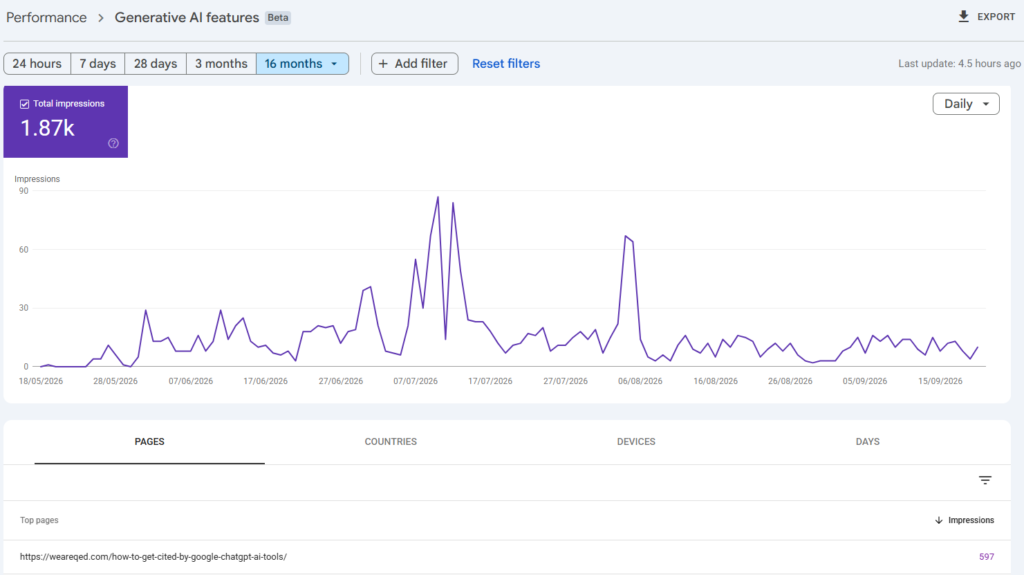
We see that on our own site. Between November 2025 and May 2026, QED Web Design recorded 20+ referral visits from ChatGPT to six of our articles, measured with WP Statistics, which only counts clicked citations. The pages cited were specific, factual articles on narrow topics rather than general advice, the pattern we explain in how to get cited by ChatGPT.
But what about the blogging statistics you have probably seen quoted for years? The next section looks at where they came from.
Are the famous old blogging statistics still true?
The two most quoted blogging statistics, “126% more lead growth” and “67% more leads”, are real but old. Both come from HubSpot’s analysis of its own customers around 2010, and they reflect a time when publishing more pages was the main way to win in search.
The first comes from a HubSpot study of 2,300 of its customers, in which blogging businesses saw 165% lead growth against 73% for businesses that did not blog. The 126% is the gap between those two growth rates. HubSpot’s page now shows only a 2025 “updated” stamp with no original date, and the figure was already circulating in roundups by December 2016 (IMPACT, 2016).
The second comes from HubSpot’s State of Inbound Lead Generation report, using lead data from November 2009 to January 2010. HubSpot’s own figures show the median customer with a blog got 15 leads a month against 9 for those without (HubSpot, 2010). HubSpot found the same result for B2B and B2C customers, even though many roundups now quote it as a B2B statistic.
Both are vendor figures. HubSpot sells marketing software, the samples were its own customers, and neither study shows that blogging caused the extra leads. They do show something useful, though: businesses that blogged were winning more leads more than 15 years ago, and the pattern has held ever since.
Look at the thinking behind them, too. The same 2010 report said a blog needed a critical mass of 20 to 50 articles before leads started to grow. In 2010 that made sense, because more pages meant more chances to be found.
That way of thinking has aged. Google’s guidance on helpful content now treats churning out “lots of content on many different topics”, in the hope that something ranks, as a warning sign (Google Search Central). Its 2026 guide to AI search goes further, asking for “non-commodity” content built on first-hand experience rather than recycled advice (Google Search Central, 2026).
The old numbers prove blogging has worked for a long time. What has changed is how, and the next section shows what blogging well looks like now.
What do blogging statistics show about blogging well?
Blogging statistics show that the way you blog matters far more than whether you blog. In Orbit Media’s 2026 survey, 39% of marketers using six or more of its tracked practices reported strong results, against just 4% of those using one or none.
Orbit Media, a Chicago web agency, has run its blogger survey every year since 2014. The 2026 edition, published by co-founder Andy Crestodina on 8 September 2026, gathered responses from 1,042 content marketers (Orbit Media, 2026). These are self-reported results, so read them as what marketers believe is working, not a lab measurement.
The practices linked to the best results were noticeably human:
- Working with outside experts. Marketers who collaborate with influencers or experts beat the survey’s strong-results average by 2.6 times.
- Publishing original research. Original data improved the likelihood of strong results by about 50%.
- Proper editing. Having a formal editor was linked to nearly double the average rate of strong results.
- Visuals. Posts with two or three images or charts were the most likely to report strong results.
Notice what is not on that list. Orbit found that using AI made no difference to the chance of strong results either way. Blogging that works is planned, researched and edited by people who know the subject, and that is a choice of approach rather than a matter of luck.
What results has blogging delivered for UK small businesses?
Blogging has delivered page-one rankings and featured snippets for UK small businesses we work with. For North West hospitality recruiter The SV Group, QED Web Design’s SEO work between October 2025 and April 2026, built around new blog posts, took the search term “matchday chef” from position 37 to position 8. And our ‘How to Become a Freelance Chef’ post featured in Google’s “People also asked” section.

Survey-based blogging statistics are useful, but results from real sites are better. The same work lifted “temp chef agency” 29 places to position 12, earned top-three rankings for “chef recruitment Liverpool” and “hospitality networking tips”, and won a featured snippet in Google’s People Also Ask for a guide on how to become a freelance chef. New users rose 17.4%. The full story, including the technical rescue that came first, is in our SV Group case study.
We have also tested the idea on a site of our own. QED web design’s founder Neil spent 27 years in hospitality, including Michelin-starred kitchens, and built a recipe site with no backlinks, no social media profiles and no Search Console connection. He published more than 70 well-structured posts with strong internal linking, and the site reached page one for multiple recipe terms. The write-up is in our post asking Do you need backlinks to rank?
Neither result relied on paid links or tricks. That matters for a small business, because content is the part of SEO you can control.
How long does blogging take to pay off?
Blogging usually takes months, not weeks, to pay off. QED runs SEO content work for a minimum of eight months because that is the realistic time it takes to build momentum that lasts.
Most blogging statistics skip the timeline, so here it is plainly. A post has to be found, crawled, indexed and trusted before it ranks well, and a single post rarely moves the needle on its own. What builds results is a steady run of useful posts that link to each other and cover a subject properly. That is how the recipe site above reached page one with no outside help.
The reward is that a ranking post keeps working. It can bring in enquiries for years after it is published, without you paying for every visit the way you do with ads.
For everyone else, the question is what to write. The next section covers that.
What should a small business blog about?
 A small business should blog about the questions its customers ask before they buy. Comparisons, costs, explainers and honest advice from your own experience are the posts that rank, convert and get cited.
The BuzzStream study backs this up. Within the blog content AI tools cited, comparison pieces were the largest group at 26.92%, followed by market analysis at 23.06% and definitions or explainers at 20.57% (BuzzStream, 2026).
Start with the conversations you already have:
- The questions you answer on the phone every week.
- The “how much does it cost?” question, answered honestly with real ranges.
- Comparisons your customers are weighing up, such as repair versus replace.
- Local knowledge that a national competitor cannot fake.
- Mistakes you see people make before they come to you.
Is blogging worth it for your business?
Blogging is worth it for any UK small business whose customers search for answers before they buy. The blogging statistics are consistent: people are searching, buyers decide early, AI tools quote blog content, and well-planned posts deliver measurable rankings.
The catch is that the results go to businesses that blog with a plan: real questions, real expertise, proper structure and the patience to keep going. Occasional posts written to fill a gap rarely get there.
If you want that done for you, our SEO content creation packages start from around £450 a month for small businesses, covering keyword research, writing, optimisation and reporting. Get in touch with QED Web Design and we will tell you honestly whether blogging is worth it for your business.