TL;DR: A business website is still the one digital asset you actually own, and a well-built one builds credibility, generates leads and gives you a first impression you control.
Sustainable web design is not a trade-off against results. A lean, fast, low-carbon site tends to load quicker, convert better and rank more strongly.
At QED we build sites that balance business goals with environmental responsibility, and we are happy to be honest about where the evidence is solid and where the internet is repeating myths.
In a digital-first economy, a strong online presence is not really optional any more, whatever size your business is. Your website is the foundation of that presence: a shop window that never closes, a first impression you control, and something you actually own rather than rent from a social platform.
We say own deliberately. A social profile or a marketplace listing can vanish or change its rules overnight. A website you control is different. It is also worth saying plainly that a genuinely free website is mostly a myth, and we have written about why over on our guide to the free website trap.
This piece looks at why business websites still matter, what they honestly cost, how they help you grow, and how sustainable web design fits into all of it. Where we quote a figure, we have tried to point at a real source rather than repeat a number that has been doing the rounds for years.
What a business website is, and why it still matters
A business website is a dedicated online platform that represents your brand, your products and your services. It is the central hub where people learn what you do, get in touch, book, buy or simply decide whether they trust you.
Unlike a social media profile or a marketplace listing, a website gives you full control over branding, messaging and the customer experience. Nobody else sets the rules, drops your reach or drapes their own advertising over your work.
That first-impression job is a big part of the value. The Stanford Web Credibility Project, one of the most cited pieces of research in this area, found that a large majority of people judge a company’s credibility on the design of its website. In other words, people decide whether to take you seriously partly on how your site looks and behaves, often before they have read a word about what you actually offer.
A good business website tends to earn its keep by doing a few things well:
- Building credibility and trust before anyone speaks to you
- Being available around the clock, so your information is there when people look for it
- Opening up conversions and enquiries beyond your immediate area
- Giving you real data on how people find and use your business
- Acting as the hub that all your other marketing points back to
A well-executed website signals that you care about quality, and that impression shapes how people feel about you before they ever buy.
Does my business actually need a website?
The honest answer for almost every business is yes. Whether you run a local cafe, a professional services firm or a small e-commerce shop, a website extends your reach past the physical limits of your premises and your opening hours.
Even if most of your work comes through word of mouth, a website still earns its place. It is where people check you out after a recommendation, read your testimonials, confirm your hours and location, and decide you are the real thing. For B2B, your site is very often the first stage of the vetting process, long before anyone picks up the phone.
One QED client, The SV Group, a hospitality recruitment company, saw a measurable rise in new users after we produced and published a run of blog content for them, targeted at the areas they wanted to grow into. The full case study sets out what we did and over what period.
The real cost of a business website (and what free really means)
Free website builders exist, and for a hobby or a temporary page they can be fine. For a business that needs to be found and trusted, the free route usually comes with strings attached:
- Limited design and customisation, so you end up looking like everyone else on the same template
- The provider’s branding is stamped on your site
- Restricted features and functionality
- Little or no proper SEO control
- Performance you cannot fully influence, which affects both users and rankings
A professionally built site involves real costs, and we would rather be straight about them:
- Domain registration, paid annually
- Hosting, paid monthly or annually
- Design and build, usually a one-off or project fee
- Content creation
- Ongoing maintenance and updates
We are also going to resist quoting you a tidy “every pound spent returns X” figure here, because most of the versions floating around the web trace back to no clear source, or quietly swap currencies between the headline and the small print. What we can say with confidence is that a fast, well-structured, findable site tends to generate more enquiries than a slow, generic one, and the reasons for that are covered honestly in the sections below. If you want real UK numbers on what a site actually costs to commission, we keep our website design cost guide up to date rather than inventing a figure here.
At QED we focus on sites that deliver long-term value rather than short-term presence, with pricing that scales with what your business actually needs.
| What matters | Free website builder | Professional build |
|---|---|---|
| Upfront cost | Low or nothing | Project fee, plus hosting and domain |
| Design control | Locked to templates | Fully your own |
| Branding | Often carries the provider's branding | 100% yours |
| SEO control | Limited | Full control |
| Performance and speed | Hard to influence | Optimised for you |
| Sustainability | Often bloated | Lean by design |
| You actually own it | Rented on their terms | Yours to keep |
How a well-designed website helps you grow
A strategic website does more than sit there. It actively contributes to growth in ways you can measure.
Credibility and trust
As mentioned above, most people form a view of your credibility from your website design. A clean, current, well-organised site signals reliability. A dated or awkward one quietly raises doubts, whatever the quality of your actual work.
Customer acquisition
A well-optimised site keeps generating enquiries through search and referral traffic while you get on with the job. Our long-standing client, The Pickled Crab, has worked with us for over a decade:
Reach beyond your postcode
A website removes geographical limits, so even a small local business can reach people well outside its immediate area. That matters most for specialised products and services where your customers are spread out.
Better customer service
Clear information, FAQs and resource pages answer questions before they land in your inbox. That saves you time and gives visitors what they need faster, which is a win on both sides.
Decisions based on real data
Website analytics tell you how people find you, what they read and what makes them act. That is genuine insight you can feed back into the rest of your marketing, rather than guesswork.
For maximum impact, a business website needs clear calls to action, intuitive navigation, content worth reading, a design that works on every device, and fast loading. Those are the things we prioritise on every build.
Sustainable digital tools: the low-carbon side of the web
The web has a physical footprint. Every page view draws energy from data centres, network infrastructure and the device in someone’s hand. As environmental awareness grows, sustainable web design has become a real consideration rather than a nice-to-have.
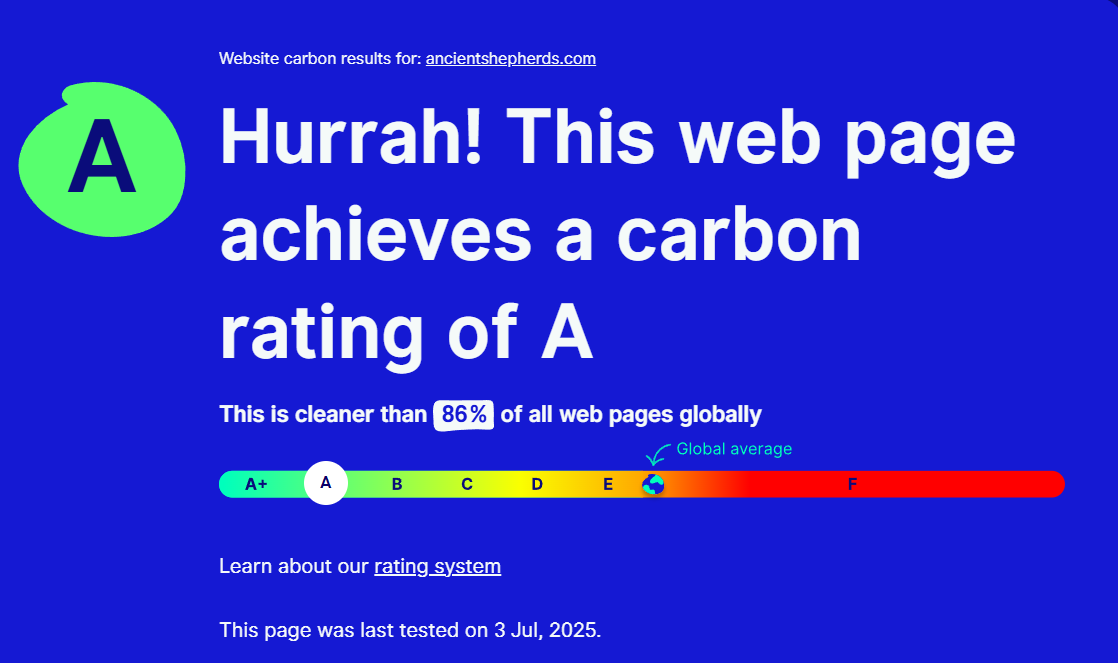
Here we need to gently correct a couple of numbers that get repeated a lot, including in the earlier version of this very page. You will often see a claim that a typical web page produces well over a gram of CO2 per view. The most widely used industry benchmark, the Website Carbon Calculator built by Wholegrain Digital, puts the current global average at roughly 0.36g of CO2 equivalent per page view. For a site with 10,000 monthly views, that works out at around 43kg of CO2 a year.
You will also see the digital sector described as responsible for a chunk of “the UK’s” carbon footprint. The credible research is about the global picture, not a single country. Estimates for the information and communications technology sector as a whole generally land somewhere between 1.5% and 4% of global greenhouse gas emissions, broadly comparable to aviation, though the exact figure depends heavily on what you include and how you measure it. Anyone quoting a single precise national percentage should be treated with caution.
None of that makes sustainable design pointless. Quite the opposite. The wide spread between efficient and wasteful pages is exactly where a good build makes a difference. At QED, sustainability is baked into how we work:
- Efficiency-first development: clean, lean code that needs less processing power, which reduces server load and improves performance at the same time.
- Sensible images and media: properly sized and compressed assets in modern formats, so pages load faster on less data.
- Greener hosting: we favour hosts running on renewable energy, which cuts the footprint of everything you publish.
The neat part is that these choices line up almost perfectly with business goals:
- Faster loading. Google’s own research, carried out with SOASTA, found that 53% of mobile visits are abandoned if a page takes longer than three seconds to load.
- Better user experience, which tends to lift conversion.
- Stronger search performance, since Google factors page experience and Core Web Vitals into rankings.
- Lower bounce rates and more engagement.
Free builder vs professional build: an honest comparison
Both routes have a place. The question is which one fits a business that needs to be found, trusted and converted. Here is how they stack up on the things that actually matter.
here
Frequently asked questions
How long does it take to build a business website?
For most UK businesses, a website project runs from roughly six to fourteen weeks, sometimes longer, depending on complexity, how much content is involved and how quickly feedback comes back.
What makes a business website sustainable?
A sustainable website uses efficient code, sensibly optimised images, a streamlined design and greener hosting to keep energy use and emissions down, while loading faster for the person visiting.
Can I update my website myself after it is built?
Yes. We build on WordPress, the most widely used content management system in the world, so you can make everyday updates without needing to touch any code.
How do I know if my website is effective?
Your analytics tell the story: more of the right traffic, longer visits, more enquiries and, ultimately, more business. If those numbers are flat, the site is not pulling its weight.
What matters more, design or functionality?
Both, and they depend on each other. Good design makes functionality feel intuitive, and solid functionality makes sure the design is doing a job rather than just looking nice.
Sources
- Website Carbon Calculator, Wholegrain Digital, average of approximately 0.36g CO2 per page view: websitecarbon.com
- Wholegrain Digital, methodology and efficiency range behind the calculator: wholegraindigital.com
- Stanford Web Credibility Project, research into how people judge site credibility: credibility.stanford.edu
- Google with SOASTA, “The Need for Mobile Speed” and mobile page speed benchmarks, 53% abandonment above three seconds: Think with Google
- Estimates for the ICT sector at roughly 1.5% to 4% of global greenhouse gas emissions, comparable to aviation: myclimate.org
If you are weighing this up in more detail, our guide on DIY versus professional web design walks through exactly when it makes sense to hire an expert. Or you can reach out to us